Home Battery Installation Requirements: Location, Permits and Safety
Ask your installer about listed equipment, location, permits, utility coordination, backup operation and safe handover before buying a home battery.
Home battery installation requirements depend on your exact equipment, location, electrical design and locally adopted rules. Ask the installer to bring those requirements together in a written proposal. An outdoor rating or battery chemistry label doesn't mean you can install the system anywhere.
This guide is for planning a professionally installed stationary system. Start with the home battery storage guide for the overall buying decision, then use the questions below to make the installation scope reviewable.
🛑 Battery equipment can contain hazardous stored energy even when the house has lost power. Leave mounting, wiring, commissioning and internal service to qualified installers working to the applicable instructions and approvals.
Confirm the complete system and its documentation
Request the exact battery, inverter, controller, isolation equipment and load-management models. Then ask whether the combination is supported and acceptable for your location. Individually marketed components don't automatically form a suitable system.
UL Solutions distinguishes UL 9540 system certification from UL 9540A fire testing. UL 9540A is a test method addressing thermal-runaway fire propagation; it is not a substitute name for certification of a complete installation. Ask the installer which listing and test documentation apply to the specific configuration and what the approving authority needs.
| Planning question | Evidence to request | Why it matters |
|---|---|---|
| What equipment is included? | Model schedule and supported combination | Backup capability depends on the system, not the battery alone |
| Which requirements govern the project? | Applicable local approval path and current manuals | Code adoption and manufacturer restrictions vary |
| Who handles approvals? | Named responsibility for permits, inspections and utility coordination | A quote should identify the complete installation scope |
| What loads will operate? | Supported-load schedule and power/energy design | A permitted installation still needs to meet the household's purpose |
Choose a location using the manual and site conditions
Have the installer check the wall or foundation, equipment weight, service access and electrical routes. Include vehicle exposure, water sources and flood risk. Ask how doors, windows, escape routes, other equipment and stored materials affect placement. Use clearances for your product and installation.
For a named manufacturer example, the Powerwall 3 safety instructions address flooding, vehicle impact, nearby water sources and environmental limits. Those are examples of the questions a manual resolves, not a universal placement rule for every battery.
- Is this exact model permitted indoors, outdoors or only in specified locations?
- What space must remain clear for safety, cooling, access and service?
- Will heat, cold, direct sun or snow affect charging or output?
- Does the location need impact protection or another site modification?
- Who restores walls, finishes and weather protection after installation?
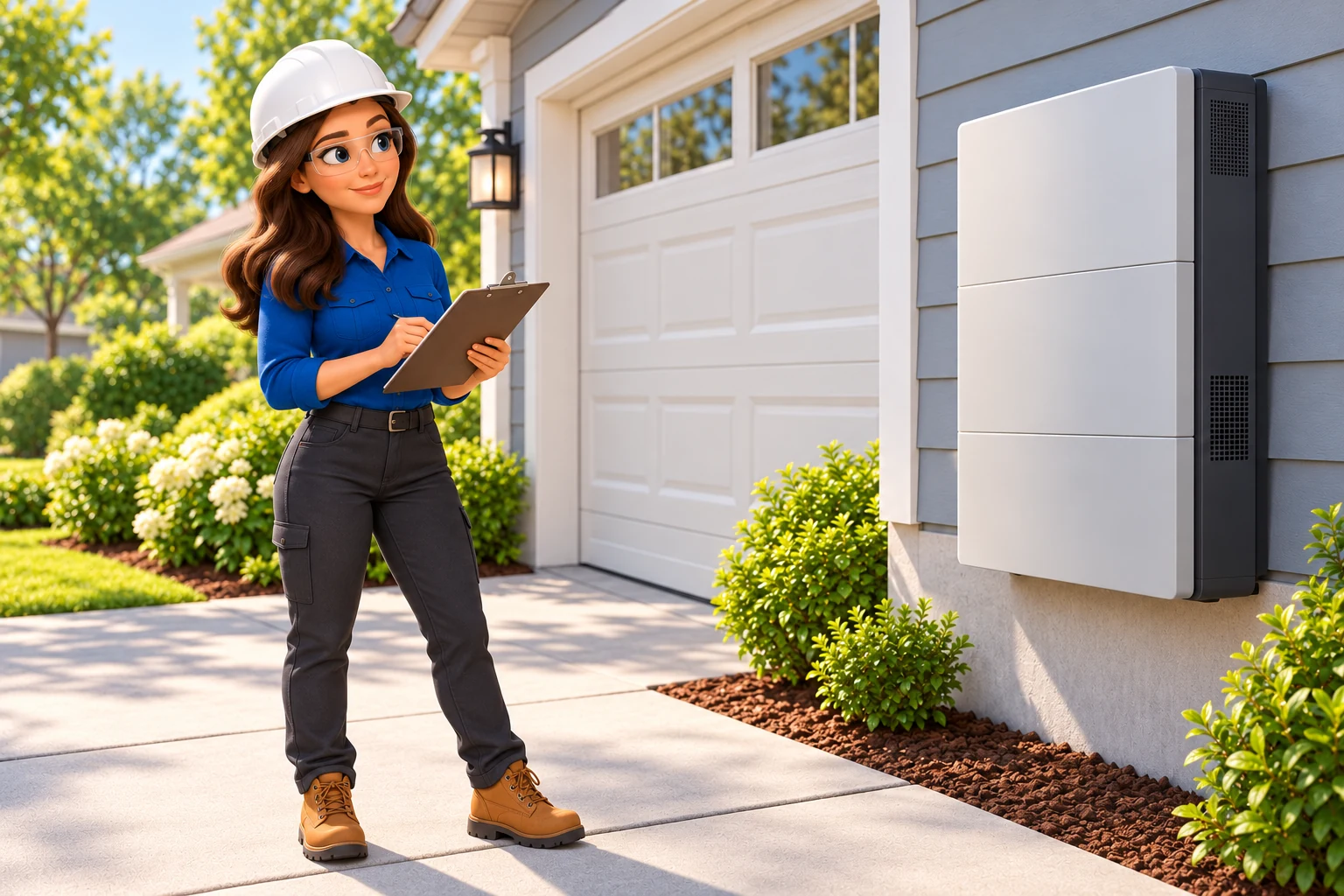
The hero illustration is a planning scene, not a dimensioned installation diagram or proof that its depicted location would be approved.
Resolve permits and utility coordination before work
Ask your local building or electrical authority which review and inspections apply. Have the installer identify adopted requirements and any fire-department review for the location. A national model standard doesn't tell you which edition your area uses.
Separately confirm utility interconnection, export limits, metering and permission-to-operate requirements where applicable. A system described as non-exporting should not be assumed exempt from every utility or local approval. If existing solar is involved, ask whether the change affects its agreement or export compensation; see net metering vs net billing.
Agree in writing who handles applications, fees, inspections, corrections and final documentation. Include any service or panel work in the price. If there's an allowance, ask what it covers and how the final cost will be set.
Specify backup and transfer behavior
A battery for daily bill management may be installed differently from one that powers household circuits during an outage. Ask which operating modes are supported, what provides approved grid isolation and which loads will be available.
The whole-home vs critical-loads comparison helps define circuit coverage. The sizing worksheet separately checks energy and output. Identify large motors, heating accessories, load shedding and restoration behavior before commissioning.
🛑 Never improvise a connection that feeds household wiring through an ordinary receptacle. Have a qualified installer provide the approved transfer and isolation arrangement for the exact system.
Ask what happens if communications fail, the battery runs down or utility power returns. Record which controls work locally and which depend on a network service.
🛑 Medical or other continuity-critical equipment needs its own equipment-specific backup plan. Do not assume household transfer is interruption-free; confirm the equipment's requirements with its provider.
Plan safe ownership and emergencies
Before handover, get the owner's manual, emergency contacts and system model information. Ask the installer to show permitted owner controls and explain how to tell responders that storage is present. Keep access routes and required equipment space clear afterward.
🛑 If a battery produces smoke, fire or other signs of an immediate safety threat, move people away and call 911 from a safe place. Do not approach the equipment to open it, investigate or operate a switch through smoke, heat or floodwater.
The Powerwall emergency instructions begin with contacting emergency responders and ensuring people can evacuate, and condition further actions on safety. Obtain the instructions for the actual product; do not use another manufacturer's switching sequence.
🛑 Keep away from flooded or visibly damaged battery equipment and arrange qualified assessment before reuse. Do not open an enclosure or restart a damaged system merely because the water has receded.
Collect a complete handover
Ask the installer to demonstrate backup under controlled conditions using approved procedures. Keep a record of the tests, supported loads and remaining limits. A full-battery app display doesn't show whether transfer and supported-load operation work.
- Collect final permits, inspection records and utility documentation as applicable.
- Save the equipment schedule, manuals, supported-load schedule and commissioning record.
- Confirm monitoring access, owner settings and support contacts.
- Record maintenance, registration, connectivity and warranty obligations.
- Keep the written installer workmanship terms with the manufacturer's warranty.
Use the battery warranty comparison to check responsibilities. If solar is part of the design, the AC- vs DC-coupling guide identifies compatibility questions to resolve before the equipment is ordered.
Conclusion
Check the exact equipment, location, local approvals, utility requirements and demonstrated operation before accepting an installation proposal. Those details establish whether the system can provide the backup you want.
Continue reading our Energy Efficiency guides.

Scott Harding
Scott is the main author of DIY Home Comfort. Learn more about the team and our approach on the About page.