Eco-Friendly Refrigerants: GWP, Safety and U.S. HVAC Rules
Understand lower-GWP refrigerants, current HFC transitions, A1/A2L/A3 safety classes, and the limits on retrofits, piping reuse and recovered refrigerant.
A refrigerant with lower global-warming potential (GWP) can reduce one part of your HVAC system's climate impact. You still need to consider equipment efficiency, leakage, safety classification, refrigerant charge, application and service requirements. Lower GWP alone does not make a refrigerant safer, more efficient or suitable for your existing system.
This U.S. homeowner overview was checked October 30, 2026. Exact equipment instructions, current rules and local adoption govern an installation.
HFC phasedown is not a universal service ban
The U.S. HFC allowance program reduces permitted bulk production and consumption relative to its baseline. Remaining caps are 60% for 2024–2028, 30% for 2029–2033, 20% for 2034–2035 and 15% from 2036. Those are remaining allowance levels, not the percentage reduction already achieved.
The EPA HFC phasedown explanation distinguishes this program from product and system restrictions. It does not establish the retail price, availability or replacement date for every homeowner's refrigerant.
New-equipment restrictions and the 2026 inventory revision
Technology Transitions rules set subsector-specific requirements for new products and systems. Manufacturing/importing, installation and servicing are different activities. R-410A equipment did not become universally illegal to use or service in 2025.
EPA's current sector restrictions include the 2026 revision: qualifying residential/light-commercial systems whose specified components were all manufactured or imported before January 1, 2025 no longer face the former installation deadline. Other conditions and subsectors still need their own checks. Do not treat that inventory exception as blanket permission for every new R-410A installation.
Safety classes describe different hazards
ASHRAE safety groups combine toxicity classification with flammability classification. A1 denotes lower toxicity and no flame propagation under the specified test; A2L denotes lower toxicity and lower flammability with limited burning velocity; A3 denotes lower toxicity and higher flammability. A1 does not mean harmless, and A2L is not a GWP category.
The ASHRAE safety-classification fact sheet explains the classification framework. Refrigerants can present pressure, cold-burn, oxygen-displacement or decomposition hazards, with additional flammability concerns where applicable. Do not use nonstandard A1L or A3L labels as established safety groups.
Detection, room size and listed equipment
Charge limits, installation area, ventilation and mitigation depend on the refrigerant, equipment listing, application and instructions. There is no universal 700-square-foot room rule for all A2L systems. A mitigation threshold stated as a fraction of a refrigerant's lower flammability limit is not a generic field setting for every closet.
The UL explanation of refrigerant detection systems describes integral listed-equipment requirements. Use the exact instructions. A larger pipe is not automatically a fire-risk reduction, and detection devices do not make an unauthorized installation acceptable.
Retrofits and existing piping
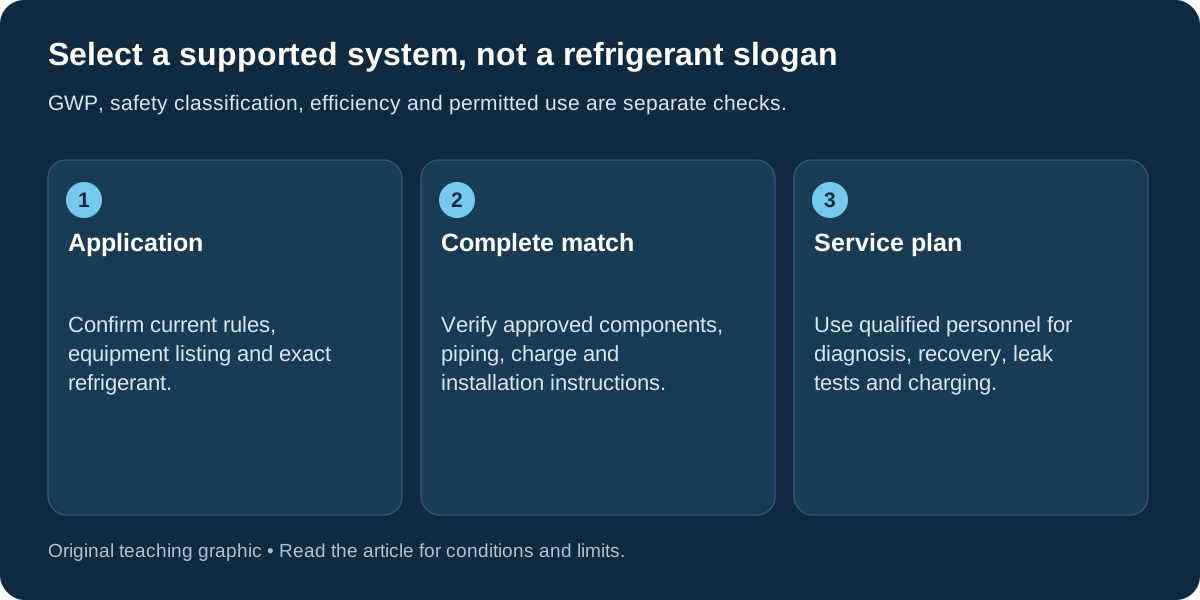
🛑 Do not put a different refrigerant into equipment unless the manufacturer and applicable requirements explicitly permit that conversion. Different pressures, oils, materials, controls and safety provisions matter. New lower-GWP equipment should not be assembled from unsupported indoor/outdoor combinations.
🛑 Existing copper piping is not automatically reusable or automatically condemned because it once carried R-410A. The manufacturer installation requirements illustrate checks for dimensions, wall thickness, cleanliness and suitability. Qualified personnel must evaluate the exact installation, not assume a universal drop-in replacement.
Recovery, recycling and reclamation
Recovery removes refrigerant; recycling cleans it through defined processing; reclamation brings it to the required purity through an EPA-certified reclaimer. Their legal meanings differ. Under the relevant Section 608 rules, refrigerant returned to equipment of the same owner is treated differently from refrigerant sold or transferred to another owner, which generally requires reclamation. Other applicable sector rules must also be checked.
Use EPA's reclamation requirements. Homeowners should not vent, mix, transfer or add refrigerant. Have qualified personnel document the approved refrigerant and service work.
Cost, incentives and purchase decisions
Refrigerant choice alone does not establish a fixed efficiency gain, future price spike or project payback. Compare complete matched-system performance and installed scope. Propane and CO2 have useful applications, but are not generic drop-in choices for a U.S. central home system.
Former federal homeowner 25C/25D credits ended for the relevant post-2025 timing, as described in the IRS instructions. Do not subtract an obsolete credit from a new 2026 project. Check separate current state or utility eligibility before counting an incentive.
Conclusion
Choose a complete, supported system with an appropriate refrigerant and qualified service plan. Compare climate impact alongside efficiency, charge, leakage and safety using our heat-pump buying guide, rather than replacing functioning equipment solely because of a blanket phaseout claim.
Continue with our heat-pump guides for related homeowner decisions.

Scott Harding
Scott is the main author of DIY Home Comfort. Learn more about the team and our approach on the About page.