Heat Pump Buying Guide: Choosing the Right System for Your Home
Use this heat pump buying guide to compare sizing, cold-weather performance, system layouts and installation quotes before choosing equipment for your home.

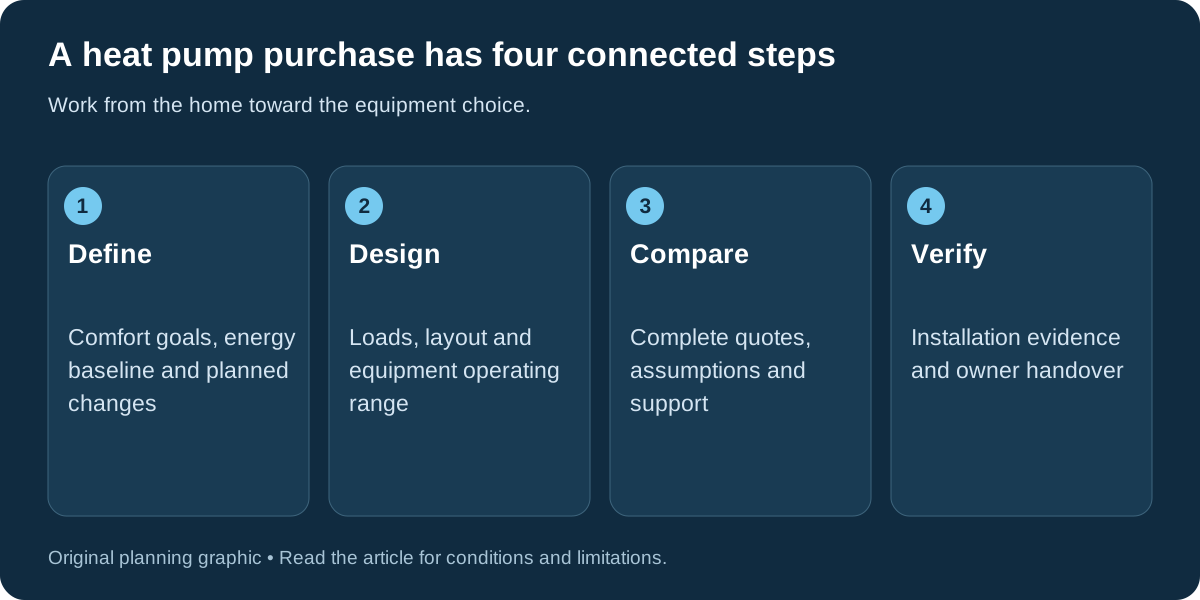
This heat pump buying guide helps you compare a complete installation. Start with your home's heating and cooling needs, the equipment's operating range and how heated or cooled air will reach each room. Check the work included in the quote. Then compare brands and seasonal-efficiency ratings.
Use this guide if you're replacing equipment or moving away from an existing heating system in a U.S. home. It covers residential air-source equipment and points you to separate guidance for heat pump water heaters. The linked guides help you plan; your home still needs a site-specific design.
Start with your home and what you want to improve
Write a short project brief before requesting equipment recommendations. Are you replacing a failed air conditioner, trying to improve an uncomfortable bedroom, adding cooling to a house with a boiler, or changing the primary heating fuel? These projects can call for different layouts and backup strategies.
Collect the current equipment model numbers, recent service findings and a year of available energy bills. Record which rooms are uncomfortable and when. A higher bill alone does not establish that the equipment is failing: rates, weather and household changes also matter. Our energy-bill guide helps separate usage from charges.
Tell prospective designers about planned air sealing, insulation, additions or window changes. Those improvements can change the load the equipment needs to meet. Coordinate their timing with the home energy upgrade order, especially if a replacement can be planned rather than rushed.
Choose a heat pump layout before comparing model names
An air-source heat pump moves heat between indoor and outdoor air. In cooling mode it removes heat from the home; in heating mode it transfers heat indoors. The existing heat pump basics guide explains that process. The buying decision then becomes how the equipment connects to your rooms.
| Layout | Where it may fit | What the quote should establish |
|---|---|---|
| Central ducted | A house served by suitable ducts, or a project that includes new distribution | Duct condition, required airflow, return paths and equipment compatibility |
| One ductless zone | A defined room or open area with an identified load | Indoor-unit position, room coverage, drainage and outdoor-unit location |
| Multiple ductless zones | Several rooms needing their own indoor units | Each room's load, allowed equipment combination and shared operating limits |
| Several independent systems | A project where separate equipment and outdoor locations are practical | Complete installed scope, operating independence and total maintenance needs |
Start with ductless versus ducted heat pumps. If ductless equipment looks suitable, compare single zone vs multi zone mini split layouts, including several independent single-zone systems. A wall unit in a hallway does not automatically establish adequate conditioning in bedrooms behind closed doors.
Ground-source and water-source systems involve different site and design questions; their feasibility needs a separate assessment. This guide does not treat an air-source quote as interchangeable with those technologies.
Require sizing evidence and a matched equipment selection
Your home's floor area helps with planning, but it isn't an equipment size. Ask for documented heating and cooling loads based on the building, room conditions and design weather. Then ask how the proposed model combination's available capacity compares with those loads.
Our heat pump sizing guide separates Manual J load calculations, Manual S equipment selection and Manual D duct design. It also explains why nominal tonnage and the capacity listed at one test point cannot answer every heating, cooling and airflow question.
ENERGY STAR's installation guidance emphasizes sizing from the home's characteristics alongside airflow, refrigerant-charge verification and duct evaluation. Request these as defined parts of the work rather than assuming they accompany an expensive unit.
Check cold-weather capacity, efficiency and backup separately
Similar seasonal ratings can hide differences in low-temperature capacity and operating range. Ask for heating-output and efficiency data for the exact proposed combination at your design temperatures. The coldest advertised operating temperature doesn't prove the system can meet your whole home's load there.
Use cold climate heat pump performance to understand capacity tables, coefficient of performance (COP), defrost and backup heat. COP describes heat delivered relative to electrical input at stated conditions; it is not the same quantity as heating capacity.
Agree on a backup strategy. The design may use electric resistance heat, an existing compatible furnace or another specified heat source. Ask what happens in unusually cold weather, during defrost, after a fault and in a power outage. Ordinary grid-powered equipment still needs electricity, even when it has another heating mode.
For a furnace-and-heat-pump system, the dual fuel heat pump balance point guide distinguishes the thermal capacity limit from cost-based switchover. A contractor must configure compatible controls; there is no universal temperature every homeowner should enter.
Use ratings and operating costs for different comparisons
Seasonal ratings help compare equipment tested under defined procedures. They do not include every condition in your house. Read HVAC efficiency ratings before comparing SEER2, EER2 or HSPF2, and ask for the exact indoor and outdoor model combination rather than a brand's highest advertised number.
For operating-cost estimates, ask which heating demand, weather, electricity tariff, fuel price and backup assumptions the contractor used. A tariff sets the electricity pricing rules. Separate variable energy charges from fixed charges you'll still pay. Removing a gas furnace may not remove the gas account charge if you keep another gas appliance.
Compare installed cost, annual operating cost and comfort improvements separately. Ask how the proposal supports each expected benefit. Savings and payback will vary by home. Compare alternatives over the same period and include maintenance, financing and remaining equipment value where relevant.
To compare the extra cost with a realistic replacement, use the energy efficiency payback calculation. Keep equipment design, annual bills and lifetime costs as separate checks.
Compare installation quotes and agree on completion evidence
Give bidders the same project brief and ask each to identify exclusions. A quote that includes duct repairs, electrical work and commissioning cannot be judged solely against the equipment price in another offer. Our heat pump installation quotes guide provides the comparison framework.
- Record exact models, controls and the equipment-selection basis.
- Define electrical, distribution, drainage, mounting, removal and permit responsibilities.
- Confirm equipment-specific tests and the records you receive when the installation is complete.
- Separate manufacturer parts coverage from contractor labor coverage and registration conditions.
- Document unresolved seasonal checks and who will complete them.
🛑 Use the HVAC commissioning checklist to specify the handover. Electrical, refrigerant, combustion and internal equipment work belongs with qualified personnel. The homeowner's role is to request evidence, understand owner-accessible care and report whether the original comfort problem improved.
Plan heat pump water heating as its own project
A heat pump water heater supplies domestic hot water. It doesn't replace your space-heating system. Because it draws heat from its source air, you need to consider the room, air pathway, ambient conditions and nearby occupied spaces.
Begin with heat pump water heater sizing for peak-hour demand, first-hour rating, recovery, clearance and placement. A larger storage label alone does not establish that a particular unit can support your household's busiest sequence of uses.
Next, review heat pump water heater settings for modes, schedules and resistance-backup trade-offs. Check temperature and vacation decisions against your exact manual and household needs. Keep the required scalding and water-hygiene safeguards in place; a general internet setting can't replace that assessment.
Conclusion
Start your heat pump choice with the home. Define the problem, compare layouts, and ask for sizing and low-temperature evidence. Then compare complete installation quotes. Keep the proposed models, assumptions and completion requirements together so you can check what you're buying.
Keep planning your next improvement: read more Energy Efficiency articles about reducing demand, improving HVAC performance and coordinating upgrades across the home.

Scott Harding
Scott is the main author of DIY Home Comfort. Learn more about the team and our approach on the About page.