Dual Fuel Heat Pump Balance Point: Costs and Capacity
Understand the dual fuel heat pump balance point, compare electricity and fuel costs, and separate economic switchover from heating-capacity limits.

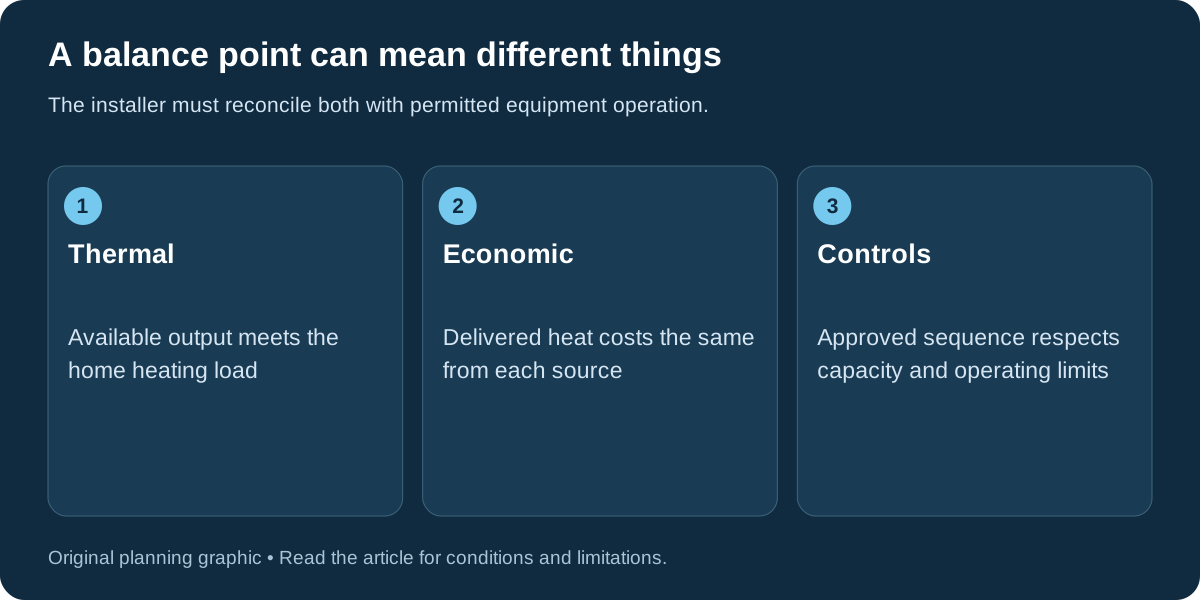
The dual fuel heat pump balance point can mean two different things. One is the temperature where the heat pump can no longer meet your home's heating demand alone. The other is where the furnace becomes cheaper to run. Those temperatures may differ.
A useful dual-fuel plan checks both points and follows the manufacturer's permitted control sequence. This guide walks through a natural-gas comparison for U.S. homeowners. If you're still choosing the system, start with our heat pump buying guide.
Separate the economic and thermal balance points
The thermal or capacity balance point is where available heat-pump output equals your home's heating load. Below that temperature, another heat source may need to cover a shortfall. Your building and selected equipment determine where the point falls.
The economic balance point is about running cost. Under which conditions does the heat pump deliver useful heat for less than the furnace? You need electricity price, fuel price and equipment efficiency to answer that question.
Also check the equipment's permitted operating range. A price calculation cannot authorize operation beyond that range. Our cold climate heat pump performance guide explains the capacity and temperature data behind the physical comparison.
Carrier's dual-fuel overview describes a heat pump and furnace working under coordinated controls and notes that the switching point depends on the system and its circumstances. Avoid adopting a single outdoor temperature from another household.
Collect the energy prices that change with use
Use the applicable marginal electricity price in dollars per kWh and natural-gas price in dollars per therm. Marginal means the charge for the additional energy you use. Include usage-related delivery charges and taxes where applicable. Dividing the whole bill by consumption can overstate this price if the bill includes fixed monthly charges.
Fixed gas service charges normally remain if you keep the furnace or other gas appliances. Any genuinely avoidable charge belongs in a separate annual whole-project comparison. It should not silently inflate the furnace's incremental fuel price while the gas connection stays active.
Time-of-use pricing can change the answer by hour. Tiered rates, seasonal tariffs or demand charges may need a more detailed model than the example below. Use your actual tariff terms rather than a national average.
Our energy-bill guide helps separate energy units and charges before you collect the inputs.
Compare the cost of the same useful heat
One therm contains 100,000 Btu. One kWh represents about 3,412 Btu. The EIA unit-conversion reference provides those energy relationships.
For a simplified natural-gas calculation, use the furnace's annual fuel utilization efficiency (AFUE) as an estimate of how much fuel becomes useful heat over a season. Write it as a decimal. For the heat pump, use a coefficient of performance (COP) for the conditions you're comparing. COP compares useful heat delivered with electricity used; check what that electricity figure includes.
- Furnace cost per 100,000 Btu of useful heat: gas price per therm ÷ furnace efficiency.
- Heat-pump cost per 100,000 Btu of useful heat: 29.31 × electricity price per kWh ÷ COP.
- Break-even COP: 29.31 × electricity price × furnace efficiency ÷ gas price.
The 29.31 factor is approximately 100,000 ÷ 3,412. This is a fuel-versus-electricity screening calculation, not a complete system model. AFUE is a seasonal rating, not an exact instantaneous field efficiency; distribution losses and loads outside the stated boundary need separate consideration.
Work through a hypothetical break-even COP
Assume electricity costs $0.18/kWh, natural gas costs $1.50/therm, and furnace AFUE is 95%, represented as 0.95. These are invented inputs for illustration, not current national prices.
The furnace's approximate cost is $1.50 ÷ 0.95, or $1.58 per 100,000 Btu of useful heat. The heat pump's corresponding cost is 29.31 × $0.18 ÷ COP, or about $5.28 ÷ COP.
| Assumed heat-pump COP | Heat-pump cost per 100,000 Btu useful heat | Furnace comparison |
|---|---|---|
| 4.0 | About $1.32 | Heat pump costs less in this example |
| 3.0 | About $1.76 | Furnace costs less in this example |
| 2.0 | About $2.64 | Furnace costs less in this example |
The break-even COP is 29.31 × 0.18 × 0.95 ÷ 1.50, or approximately 3.34. Above that COP, heat-pump running cost is lower under these assumptions. Below it, the furnace's modeled fuel cost is lower. This threshold is a COP, not a temperature setting.
The table excludes separate furnace blower electricity, differences in distribution losses, cycling, startup behavior, defrost and other unmodeled energy. Those can affect the real comparison, especially when the estimated costs are close.
Turn the COP threshold into a design question
Ask the contractor to compare your calculated threshold with performance data for the exact installed combination. Check the outdoor and indoor conditions, output level and input power. Ask what the reported COP includes.
There may be more than one temperature crossing, or no simple crossing. Output level, variable-capacity behavior and changing electricity prices can complicate the result. Stay within published performance limits; a few table entries don't support estimates beyond them.
Ask separately where available heat-pump capacity falls below the building load. Our heat pump sizing guide explains the design record. If the system cannot supply enough heat at a condition, a favorable COP calculation does not remove that capacity requirement.
Have the installer document the permitted control strategy
“Balance point,” “compressor lockout,” “auxiliary heat” and “emergency heat” can mean different functions on different controls. Request an explanation tied to the equipment and thermostat actually being installed.
For example, the Trane XR302/XR303 thermostat instructions describe a dual-fuel configuration that switches to gas heating and stops the compressor. That is one documented control example, not a procedure to apply to every system.
🛑 Do not assume the heat pump and furnace can run together, alter installer-only settings, or disable backup equipment to chase the calculated price threshold. Have a qualified installer reconcile capacity, approved operating sequence, comfort and safety requirements. Request a written explanation of how the system responds during defrost, a fault or an unusually cold event.
Separate the running-cost threshold from the purchase decision
Break-even COP doesn't tell you annual savings, payback or which equipment to buy. For those decisions, you need heating demand over time, applicable prices, installed costs, maintenance and the proposed controls. The method works nationally, but climate and local rates change the answer.
If the goal is removing gas entirely, compare an appropriately designed all-electric system with the retained-furnace option as separate projects. Include any genuinely avoidable fixed charges and the costs of serving remaining gas loads. Do not mix that decision into a switching calculation for a furnace that stays connected.
Use the heat pump versus gas furnace guide for the wider equipment comparison and the installation quotes guide to define the included scope.
Record why each setting was chosen
Save the tariff date, prices, efficiency assumptions, performance-data source and installer's chosen strategy. Note whether an operating-cost objective, capacity limit or manufacturer requirement determined each setting.
Revisit the cost assumptions when tariffs change, and ask the installer whether the approved configuration needs review. Compare later energy use with weather and household changes in mind. The HVAC commissioning checklist helps keep control demonstrations and follow-up items with the other installation records.
Conclusion
Keep capacity, running cost and permitted operation separate in a dual-fuel comparison. Calculate the COP threshold with clear assumptions. Then ask your installer to relate it to your actual equipment and building before choosing a switching strategy.
Continue your planning: read more Energy Efficiency articles on heat-pump selection, energy bills and whole-home upgrade decisions.

Scott Harding
Scott is the main author of DIY Home Comfort. Learn more about the team and our approach on the About page.