Heat Pump Installation Quotes: What to Compare
Compare heat pump installation quotes with a blank three-bid worksheet covering equipment, scope, electrical work, commissioning, exclusions and warranties.

Heat pump installation quotes should tell you exactly what you're buying. Look for the equipment, sizing basis, installation work, electrical and control requirements, completion checks and warranty responsibilities. Compare those details across bids before choosing by total price.
Start with a written project brief, request itemized proposals and record missing items before comparing totals. This guide provides a practical review method for U.S. homeowners. Use the heat pump buying guide first if you are still deciding which type of system fits your home.
Give each contractor the same project brief
Describe your existing system and recent service findings. List uncomfortable rooms, how you use them and your typical thermostat settings. Include known moisture problems and planned home changes. Share available bills and explain any occupancy or rate changes that affected them.
Tell each contractor your main goal: replace failed equipment, add cooling, reduce fuel use or improve room comfort. Explain what needs to stay, such as existing heating backup, and what you're willing to change. Keep that brief consistent so you can compare all-electric and retained-furnace designs fairly.
ENERGY STAR's contractor hiring guidance recommends a home evaluation, written itemized estimates and checking references and applicable licensing and insurance. Ask who will perform and supervise the work, including subcontracted electrical tasks.
What should heat pump installation quotes include?
Ask for heating and cooling load calculations and an explanation of the selected capacity. The heat pump sizing guide explains the relationship between the load calculation, equipment selection and distribution design. “Same size as before” is a description of a replacement, not the design evidence.
List every major component: outdoor unit, indoor coil or air handler, ductless indoor units, controller and any backup equipment. Ask for matched-system documentation and the ratings for that exact combination. The brand's highest advertised efficiency may apply to a different package.
For a heating-led design, request capacity and efficiency at relevant outdoor temperatures, not just the lowest temperature at which the unit can operate. Read cold climate heat pump performance before comparing those figures. If a furnace remains, ask how the proposed dual fuel balance-point strategy will be selected and documented.
Build a side-by-side quote comparison
Use the same comparison rows for every bidder. Mark each item as included, excluded, an allowance or unanswered. An allowance is a budgeted amount for work that still needs clarification. Ask how the final charge will be set and how any difference will be handled.
| Quote item | What to record | Clarification to request |
|---|---|---|
| Design and equipment | Load summary, models, capacities and matched ratings | What home assumptions and combinations were used? |
| Ducts or indoor zones | Repairs, new runs, indoor-unit locations and room coverage | Which existing comfort problem does each item address? |
| Electrical and controls | Circuits, assessed upgrades, controller and backup setup | Who confirms the required electrical scope? |
| Refrigerant and drainage | Line-set scope, routing, drainage and protective details | What is new, what is reused and why is reuse acceptable? |
| Site work | Supports, access, removal, repairs and disposal | Who completes and pays for finishing work? |
| Completion and support | Testing, records, training, warranties and follow-up | What proves completion, and who handles unresolved items? |
Copy the blank table into your notes and keep it beside the original proposals. Write included, excluded, allowance or unanswered where appropriate. A blank or unanswered item is not a zero-dollar cost.
| Item to compare | Bid A | Bid B | Bid C |
|---|---|---|---|
| Outdoor and indoor model numbers | ________ | ________ | ________ |
| Sizing/design evidence | ________ | ________ | ________ |
| Ducts, zones and electrical work | ________ | ________ | ________ |
| Controls and backup heat | ________ | ________ | ________ |
| Permits, removal and finishing | ________ | ________ | ________ |
| Setup checks (commissioning) and owner instructions (handover) | ________ | ________ | ________ |
| Parts, labor and follow-up | ________ | ________ | ________ |
| Gross installed cash price | ________ | ________ | ________ |
| Required work excluded from price | ________ | ________ | ________ |
| Comparable total for agreed scope | ________ | ________ | ________ |
Comparable total = gross installed cash price + confirmed required work excluded from that price. Do not add a cost already included, or subtract a conditional incentive as though it were guaranteed. An unresolved allowance or exclusion means the totals are not yet fully comparable. This worksheet does not replace the complete contract or equipment requirements.
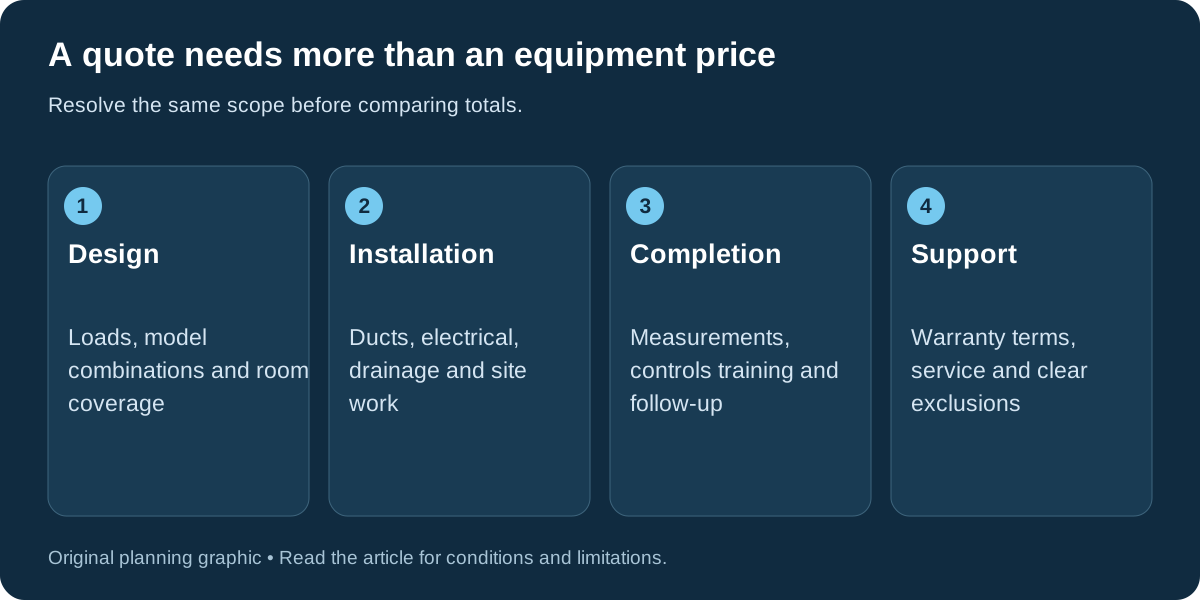
Separate distribution, electrical and site work
Ask how the existing ducts will deliver the airflow the new equipment needs. What will the contractor inspect, measure, repair and verify? For ductless proposals, map each zone and indoor unit. The single zone versus multi zone comparison explains why similar-looking bids may serve different rooms.
ENERGY STAR's quality-installation guidance identifies sizing, airflow, refrigerant charge and duct evaluation as important checks. Ask which of those are included and which require a separate assessment.
🛑 Have qualified personnel determine the electrical requirements, including backup heat and any necessary service or circuit work. Do not assume a panel replacement is always required or always avoidable. Also identify responsibility for permits and inspections where applicable, wall repairs, weather protection, equipment removal and cleanup.
Include commissioning and owner instructions in the price
Ask for a written completion scope before installation day. The Building America commissioning guide describes equipment-appropriate refrigerant and control checks, with additional airflow, pressure and duct checks for ducted systems. Qualified technicians perform these procedures; the homeowner requests the records.
Use our HVAC commissioning checklist to plan the final checks and instructions. Agree on the measurements, test conditions and acceptance criteria: what counts as a satisfactory result. Include a follow-up plan for checks that need different weather.
Ask for a demonstration of normal settings, filters, scheduled maintenance and backup behavior. Find out whom to contact for faults. Who will follow up if a room still doesn't meet the agreed comfort goal? Get those answers rather than relying on a “startup included” line.
Compare gross prices, exclusions and payment terms
Compare the installed price before potential rebates, tax benefits or financing incentives. Record any discount separately and verify its current eligibility, timing and responsible applicant before counting it. This guide does not assume that a particular federal credit or local program is available.
Hypothetical Example
Compare Complete Quotes
$13,500 vs $13,000Consider a hypothetical comparison: Quote A is $12,000 and excludes $1,500 of required electrical work; Quote B is $13,000 and includes the same work. On those limited stated inputs, A totals $13,500 and B totals $13,000. This arithmetic is not a national price estimate, and it does not establish equivalence in equipment, warranty or design quality.
Request the cash price separately from financed payments. Record financing charges and repayment conditions if relevant. Ask how changes are authorized, what triggers progress payments and what evidence accompanies completion. Resolve project-specific contract questions before signing.
Check warranties, support and the final written scope
Check equipment-parts coverage, any separate compressor coverage and the installer's labor warranty. Ask about registration, maintenance conditions, transferability, excluded charges and who handles claims. A long parts warranty doesn't necessarily include free service visits.
Request a realistic schedule, anticipated service disruption and arrangements for equipment delays. Check who provides ongoing service and how urgent winter faults are handled. Keep written answers with the final proposal rather than relying on a salesperson's verbal assurance.
If the bids remain difficult to compare, send each contractor the same short list of unresolved differences. Ask for a revised scope before choosing. A more complete bid may explain a higher price; an unexplained premium still deserves clarification.
Conclusion
Compare quotes for the same home, equipment needs and included work. Check what evidence you'll receive at completion. Resolve exclusions, payment terms and service responsibilities in writing so the chosen price covers the project you expect.
Continue preparing for a successful upgrade: explore more Energy Efficiency articles on equipment choices, installation quality and whole-home planning.

Scott Harding
Scott is the main author of DIY Home Comfort. Learn more about the team and our approach on the About page.