Cold Climate Heat Pump Performance: Capacity and COP
Compare cold climate heat pump performance using heating capacity, COP and low-temperature data. Learn how backup heat and home design affect the result.

To compare cold climate heat pump performance, check heating capacity, electrical input and your home's demand at the same outdoor conditions. A claim that a unit “works below zero” leaves questions. How much heat does it supply there? What does that heat cost? Can it meet your building's load?
This guide helps U.S. homeowners read the evidence behind a winter equipment proposal. Use the heat pump buying guide for the full purchase process and the heat pump sizing guide for the building-load calculation.
What a cold-climate designation establishes
A qualifying designation is a useful screening tool, with specific tested criteria. It is not a statement that every listed product fits every cold-weather house.
The current ENERGY STAR cold-climate criteria include a coefficient of performance of at least 1.75 at 5°F [−15°C]. Heating capacity at 5 degrees must also be at least 70% of the defined 47°F [8°C] capacity. Other efficiency and controls-verification requirements apply too.
Those are program test conditions. Capacity retention compares the equipment's output at two specified points. It doesn't show the percentage of your home's heating needs the unit can meet. Your design temperature may be colder than 5 degrees. Ask for relevant performance data before treating the qualification as an all-weather guarantee.
Read capacity and COP as different answers
Capacity tells you how quickly a system delivers useful heat, commonly in Btu/h. Coefficient of performance, or COP, compares heating output with electrical input in equivalent energy units. Always check the stated conditions for that COP.
More capacity doesn't automatically mean a higher COP. One product may supply enough heat in a winter condition. Another may use less electricity per unit of heat but need a different backup strategy. Check both numbers.
The International Energy Agency's explanation of heat pumps describes this output-to-input relationship. A COP measured at one set of conditions won't stay the same all winter. Outdoor conditions, output level and system operation change.
Likewise, HSPF2 is a defined seasonal rating, not the heating capacity at your coldest condition. Keep the two comparisons separate using our HVAC efficiency ratings guide.
Request a useful cold climate heat pump performance table
Ask which exact outdoor and indoor models the data covers, where the data came from and which conditions it represents. Different indoor combinations or output levels can make otherwise similar tables hard to compare.
| Information | Question it answers |
|---|---|
| Outdoor and indoor temperatures | Do these values represent the conditions being compared? |
| Maximum heating capacity | How much heat can the combination deliver at this point? |
| Minimum heating capacity | How low can output go in milder conditions? |
| Electrical input and COP | What input accompanies the stated output? |
| Test or reporting notes | What is included, and which qualifications affect interpretation? |
| Permitted operating limits | Where does the manufacturer allow the equipment to run? |
The NEEP cold-climate product-list resources provide a way to locate reported performance information. Cross-check the selected combination with current manufacturer documentation, particularly when a quote substitutes one indoor unit for another.
Use a simple example to connect output, input and load
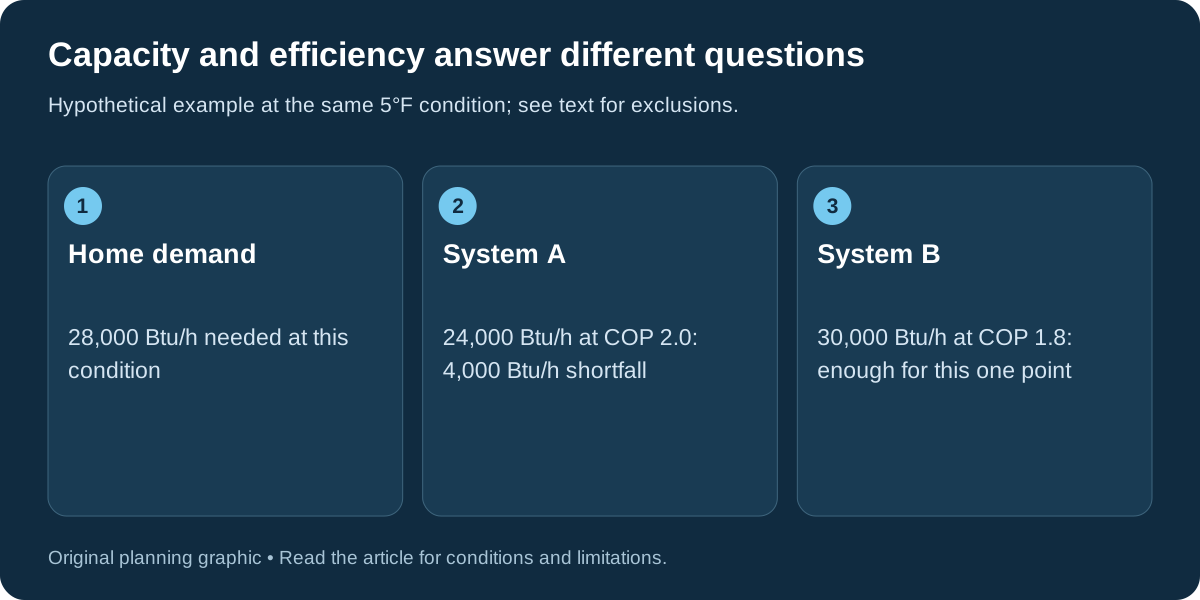
Consider an invented comparison at 5 degrees, with the same indoor conditions and the same definition of what the energy measurements include. System A delivers 24,000 Btu/h at COP 2.0. System B delivers 30,000 Btu/h at COP 1.8. The house needs 28,000 Btu/h at that condition.
System A has a 4,000 Btu/h capacity shortfall. System B has enough capacity for this single comparison, despite its lower COP. That does not make B the final choice: cooling performance, minimum output, other winter temperatures and the cost of any backup still need review.
Using approximately 3,412 Btu per kWh, A's input is 24,000 ÷ 3,412 ÷ 2.0, or about 3.52 kW. B's is 30,000 ÷ 3,412 ÷ 1.8, or about 4.88 kW. B consumes more electrical power here while also delivering more heat. Comparing only those input values would miss the different services provided.
These hypothetical points are not product ratings or a bill forecast. They exclude unlisted auxiliary loads and backup heat. The conversion factor is documented in the EIA energy-unit reference.
Find the capacity balance point for the actual house
As outdoor temperatures fall, your home generally needs more heat. Heat-pump capacity changes too. The capacity or thermal balance point is where available heat-pump output meets building demand. Below it, another heat source may need to cover the shortfall.
PNNL's cold-climate sizing guide illustrates comparing the building load line with the equipment's operating range. Ask the designer to show the relationship for your home and identify any intentional backup contribution.
The economic balance point asks a different question: when does one heat source cost less to run? Our dual fuel heat pump balance point guide separates the fuel-price calculation from the capacity assessment. A low-cost heat source still needs enough capacity and an approved operating sequence.
Check mild-weather performance and the cooling season
A system chosen for severe winter conditions will also run on many milder days. Ask how its minimum output compares with the smaller load on those days. The largest cold-weather capacity may bring other compromises.
Check the cooling selection too, including moisture removal where it matters. Ask how the proposed configuration meets both seasons' goals. Strong winter performance alone doesn't show how it will behave in summer.
If the plan uses multiple indoor units, compare the room loads and actual connected combination with our single-zone versus multi-zone mini-split guide. A collection of indoor-unit nameplate sizes is not a substitute for the system's simultaneous performance data.
Include defrost, placement and installation in the winter plan
Frost can form on an outdoor coil during heating, and automatic defrost is part of normal operation. Persistent heavy icing or trouble maintaining comfort needs assessment. Ask how the proposed system handles defrost and any backup operation it uses during that process.
Carrier's homeowner troubleshooting guidance distinguishes normal frost from abnormal icing and warns against chipping ice from the coil. Follow your equipment's instructions and arrange professional service for an unresolved problem.
Before installation, review snow accumulation, roof runoff, drainage, manufacturer clearances and service access. The answer should be an appropriate placement plan, not an improvised enclosure that blocks airflow. Use our heat pump placement guide to organize that conversation.
Keep the supporting evidence with the quote
Request the model combination, load report, design-temperature capacity, relevant COP data and backup strategy in writing. Ask which measurements and demonstrations of the controls you will receive when the work is complete.
The heat pump installation quotes guide helps compare these deliverables across bidders. For winter operating background after purchase, read how a heat pump works in winter; buying-stage performance review and day-to-day operation answer different needs.
Conclusion
Compare cold-weather output, electrical input and building demand under matching conditions. Use a qualifying label to narrow your options. Then confirm the exact equipment combination, operating range, backup plan and installation details for your home.
Keep exploring the category: read more Energy Efficiency articles on sizing, equipment performance and practical upgrade planning.

Scott Harding
Scott is the main author of DIY Home Comfort. Learn more about the team and our approach on the About page.