How to Read Your Energy Bill Before Planning Upgrades
Learn how to read your energy bill, separate usage from rates, compare billing periods and build a baseline before choosing home energy upgrades.

To learn how to read your energy bill, start with two questions: how much energy did you use, and what did you pay for it? Then check the billing days, fixed charges and anything unusual that happened that month. Higher usage, a higher rate or a longer billing period can all raise the total.
Use this worksheet to build a baseline for your U.S. home's electricity use and any natural gas or other heating fuel. Check your own bill and tariff, the utility's pricing rules, for the charges that apply. This guide doesn't recommend a particular utility rate plan.
Find the units before comparing totals
Hypothetical Example
Power And Energy
1 kW × 2 Hours = 2 kWhKilowatt-hours, or kWh, measure how much electricity you use. Kilowatts, or kW, measure power: the rate at which you use it. A device using 1 kW continuously for two hours consumes 2 kWh. A brief need for a lot of power and a high monthly energy total call for different planning.
Natural gas may be billed in therms or converted from a measured volume. A therm represents 100,000 Btu of energy. The EIA’s energy-unit reference explains these relationships. Use the billed energy quantity and conversion shown by your supplier rather than treating a measured volume and a billed energy amount as interchangeable.
Do not compare “900 kWh” with “60 therms” as if the larger number means greater energy use. Also avoid comparing input energy alone when choosing equipment: the useful heat delivered depends on the equipment’s performance. Start with a separate baseline for each fuel.
Separate usage charges from charges that remain
Read the line items, not just the amount due. A bill can include energy supply, delivery, a customer charge, taxes, adjustments and credits. Some charges change with consumption; others may remain even if usage falls.
For an illustrative electric bill, suppose 800 kWh costs $120 in supply and delivery charges that vary with usage, plus a $20 fixed charge. The total is $140. Dividing $140 by 800 gives 17.5 cents per kWh, but the variable portion in this simplified example is 15 cents per kWh.
Avoiding 100 kWh in this example would reduce the bill by an estimated $15, not $17.50. You would still pay the fixed charge. Real tariffs may include tiers, time periods, minimum bills and other adjustments. For a project estimate, use the applicable marginal charge: what the extra energy costs, or what you save by avoiding it. Ask your utility if that isn't clear.
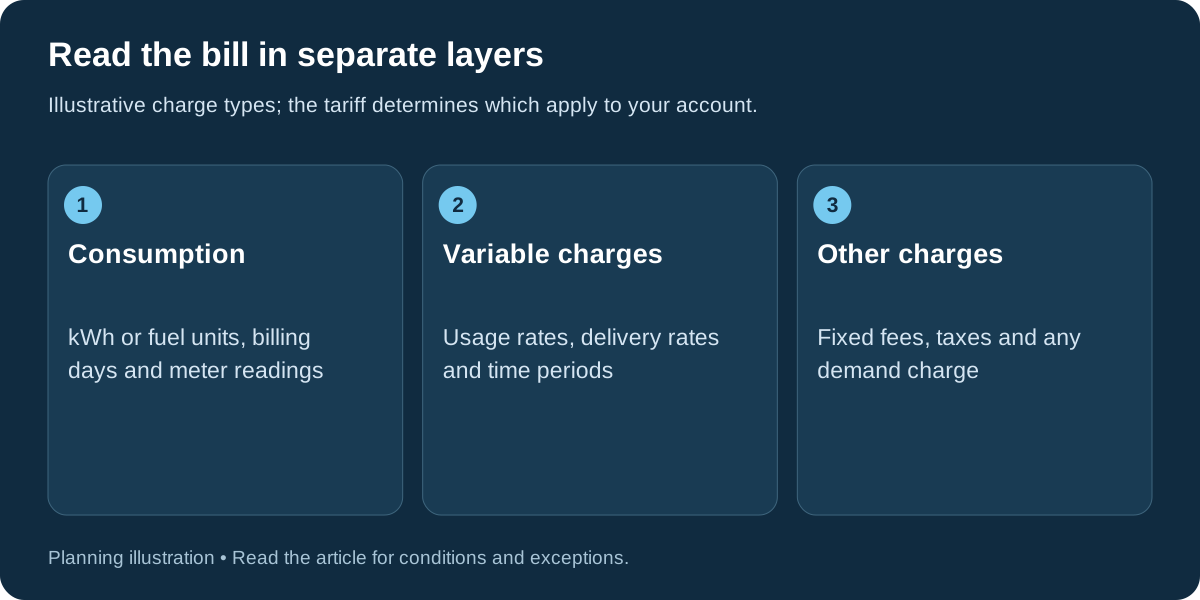
Build a monthly baseline worksheet
Use one row per billing period. Keep electricity and fuel on separate lines or sheets so you can see when one rises as another falls. These are the minimum fields worth retaining:
| Field | Why it matters |
|---|---|
| Start and end dates; billing days | Prevents unequal periods from looking like a change in performance |
| Metered usage and units | Tracks consumption independently of price |
| Actual or estimated reading | Flags later catch-up bills |
| Variable and fixed charges | Separates avoidable costs from remaining charges |
| Occupancy and equipment changes | Explains shifts in household demand |
| Weather and comfort notes | Provides context for heating and cooling |
For a simple comparison, divide usage by billing days. An illustrative 900 kWh over 30 days and 990 kWh over 33 days both equal 30 kWh per day. The second bill contains more energy without showing higher daily consumption.
Daily averages help you spot patterns. They aren't weather normalization, which accounts for differences in weather. If you arrange a home energy audit, give the provider your worksheet.
Look for patterns before assigning blame
Compare similar seasons and note big household changes. Did you add an EV, start working from home or install a hot tub? Did you adjust the thermostat or switch from gas heat to a heat pump? Electrification can raise your electric bill while lowering another fuel bill. Compare the combined operating cost.
Higher winter use may point toward space heating, but a bill can't identify every appliance. A high year-round baseline may be a reason to investigate water heating, refrigeration or equipment that runs continuously. Write down your possible explanation and look for evidence before blaming the largest appliance.
🛑 Use safe, appropriately rated plug-in monitors only as their instructions permit. Hardwired equipment and electrical-panel measurements belong with qualified professionals. For the broader decision sequence, see the home energy efficiency roadmap.
Use interval data to understand timing
If your utility offers hourly or shorter-interval usage, compare it with household routines. A repeated overnight increase could align with EV charging; afternoon peaks could coincide with cooling and cooking. Timing helps you ask better questions, but correlation alone does not identify a faulty device.
Track imported electricity, solar production and exported electricity separately. With solar, your home may use more energy than its net utility purchase shows. Before adding a battery or another electrical load, ask for an energy balance that includes generation, imports, exports and self-consumption: solar energy you use at home.
For summer peaks, start with reducing cooling load. If uncomfortable rooms point toward distribution problems, review duct sealing and insulation before attributing everything to rate timing.
If monthly totals hide when a load runs, home energy monitors and interval data may help answer a specific question, though measurements and circuit coverage vary.
Use the baseline to compare proposed upgrades
Ask each contractor which part of your actual usage their proposal can affect. A lighting improvement cannot reduce all household consumption; an HVAC estimate should distinguish heating, cooling and other loads. Keep savings assumptions, rates and the measurement period beside every calculation.
Do not treat a single mild month as proof of a project’s annual savings. Track a longer period and record changes in weather and behavior. When deciding where to spend first, bring the worksheet to the home energy upgrade-order guide.
Your baseline should answer three questions. How much energy did your home use? What did the avoidable portion cost? What changed during that period? Bring those answers to your next contractor conversation along with the annual bill total.
Check time-of-use rates and any demand charge
A time-of-use rate prices electricity differently across specified periods. If your account uses one, record the schedule and the kWh charged in each period. Shifting a task to another period may change its cost without changing its energy consumption. The EIA’s electricity pricing guide explains why electricity prices can vary with time and other conditions.
If your tariff includes a demand charge, read how the utility measures the relevant kW and billing interval. Do not assume every residential account has this charge, or that a monthly kWh reduction produces an equal reduction in peak demand. Ask the utility to explain any unfamiliar line item before using it in a solar, battery or EV-charging comparison.
Also check the meter number and whether the bill uses an actual or estimated reading. An estimated bill followed by a catch-up adjustment can distort a short comparison. Preserve those details in the baseline instead of treating every month as equally reliable.
Conclusion
Separate consumption, rates and billing conditions when you read your energy bill. Keep a baseline for each fuel and note household changes. Then use the charges that actually apply to estimate how a project could change your operating costs.
Put that baseline to work: browse more Energy Efficiency articles to connect your household's energy use with practical upgrade choices.

Scott Harding
Scott is the main author of DIY Home Comfort. Learn more about the team and our approach on the About page.