How to Reduce Cooling Load Before Replacing Your AC
Learn how to reduce cooling load with targeted shading, less indoor heat and better building performance before deciding whether to replace your AC.

If you're wondering how to reduce cooling load before buying a new AC, start with heat entering your home and heat produced inside it. Look at solar gain, avoidable indoor heat, and known building or duct problems. These steps can help comfort and replacement planning. A failing air conditioner still needs repair.
Cooling load is the heat and moisture your system must remove to keep the indoor conditions you've chosen. A fan can help you feel cooler without reducing that load. Knowing the difference helps you choose a useful low-cost measure.
Find when and where the problem begins
For several typical days, note which room feels uncomfortable, the time, sun exposure and thermostat setting. Record whether doors and shades are open. Is the whole house warm, or is one room different? That helps you decide whether to investigate the building's load or a local air distribution problem.
Try one reasonable change at a time so you can recognize its effect. If a west-facing room becomes uncomfortable only in late afternoon, shading is a more informative first experiment than permanently closing supply registers elsewhere.
Use the energy-bill baseline to understand seasonal consumption, but do not expect a bill to diagnose a single room. Persistent or unexplained problems may justify a home energy assessment.
Reduce direct solar gain at the right windows
Observe which windows receive direct sun during the uncomfortable period. Use existing shades or curtains before that exposure peaks, then compare comfort. Consider daylight, visibility, safe operation and the needs of occupants when choosing a routine.
Exterior shading blocks sunlight before it reaches the glass. DOE's window performance and selection guide explains how shading and window orientation affect performance. Choose an approach that fits your window, climate and building. You may need different treatments for different windows.
🛑 Before buying film, screens or permanent attachments, check product compatibility and relevant warranties. Do not obstruct emergency escape routes, required ventilation or equipment clearances. A targeted change at a problem window is easier to evaluate than replacing every window in response to one hot room.
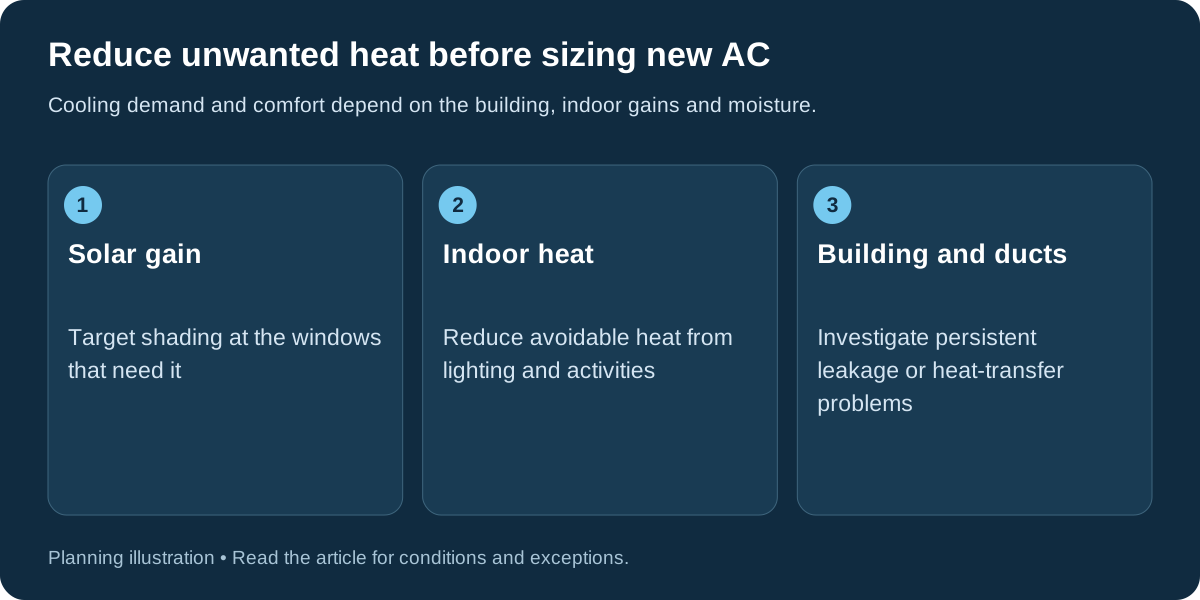
Reduce avoidable heat generated indoors
Look at cooking, lighting and equipment that operate during the hottest part of the day. Where practical, shift heat-producing activities or use suitable alternatives without compromising food safety, ventilation or household needs.
- Turn off lighting and electronics that are not needed.
- Consider efficient lighting when lamps are due for replacement.
- Use appropriate cooking ventilation, while recognizing that exhaust also moves air out of the home.
- Avoid placing heat-producing equipment beside the thermostat.
- Record unusual loads, such as a home office with several continuously operating devices.
Choose changes your household can keep up. Adjusting afternoon shades or switching off an unnecessary device is more practical than a plan that depends on never cooking dinner. Treat these as operating experiments; they don't guarantee a percentage off your cooling bill.
Use outdoor air only when conditions help
Opening windows is not always a cooling strategy. If outdoor conditions add heat, moisture, smoke or other pollutants, additional outdoor air can make comfort or air quality worse. Consider weather, humidity, security and occupant needs rather than using the clock alone.
🛑 Do not block required ventilation to reduce cooling demand. If the home needs a ventilation assessment, discuss it with the project team. Our ERV versus HRV guide introduces controlled ventilation, while the air-sealing guide explains why reducing uncontrolled leaks is a separate task.
🛑 Fans can support personal comfort, but they do not replace cooling when indoor conditions become unsafe. Do not postpone needed cooling or medical advice during dangerous heat in order to complete an efficiency experiment.
Check the pathways low-cost habits cannot fix
If shading and operating changes don't explain the problem, arrange an appropriate check of the building and distribution system. An attic boundary problem, leaking return or restricted duct branch may keep causing discomfort even with careful thermostat use.
Use the attic planning guide for top-floor concerns and the duct diagnosis guide for room-to-room delivery concerns. These guides help frame a contractor conversation rather than direct invasive DIY work.
Arrange service if your system suddenly performs poorly, leaks, ices up or makes unusual noises. Load reduction and equipment repair are separate jobs. A lower thermostat setting or larger replacement unit won't automatically fix the cause.
Carry the findings into replacement planning
Tell your HVAC designer which improvements are in place and which you've committed to. Ask for a load calculation based on those conditions. Matching the old unit's nominal size isn't enough. Discuss humidity management, air distribution and how the installation will be checked too.
For an illustrative comparison, one home may need only shading changes and a repaired duct branch; another may need attic work and a new system. The observation process helps distinguish them. It does not predict a universal savings amount or determine equipment capacity by itself.
Use the upgrade-order guide if replacement is urgent. Otherwise, return to the home energy efficiency roadmap with your findings and choose the next measure based on the remaining uncertainty.
Distinguish solar heat gain from an equipment problem
Solar heat gain is heat entering the home from sunlight. If direct sun coincides with discomfort, compare the room with its existing shades closed before that period. Record the result along with outdoor conditions. This is a useful screening observation, not a substitute for a load calculation.
Look at indoor heat separately. Suitable LED lighting can use less electricity and produce less heat than older lamps you use often. That alone doesn't tell you how much smaller your AC could be. The designer still needs to account for the whole building, ducts, occupants and moisture conditions.
Window upgrades and HVAC replacement are larger decisions. Use the observations to ask targeted questions about the source of the load instead of assuming every hot room requires both purchases.
Conclusion
Notice when heat enters your home and where avoidable indoor heat comes from. Try practical changes, investigate ongoing building or duct problems, and share the findings with your HVAC designer before choosing a replacement.
Keep working toward a more comfortable home: read more Energy Efficiency articles for guidance on reducing demand and planning your next improvement.

Scott Harding
Scott is the main author of DIY Home Comfort. Learn more about the team and our approach on the About page.