Home Energy Upgrade Order: Insulation, Heat Pump, Solar or Battery First?
Choose a home energy upgrade order that fits your house. Compare insulation, HVAC, solar and batteries while planning for urgent replacements.
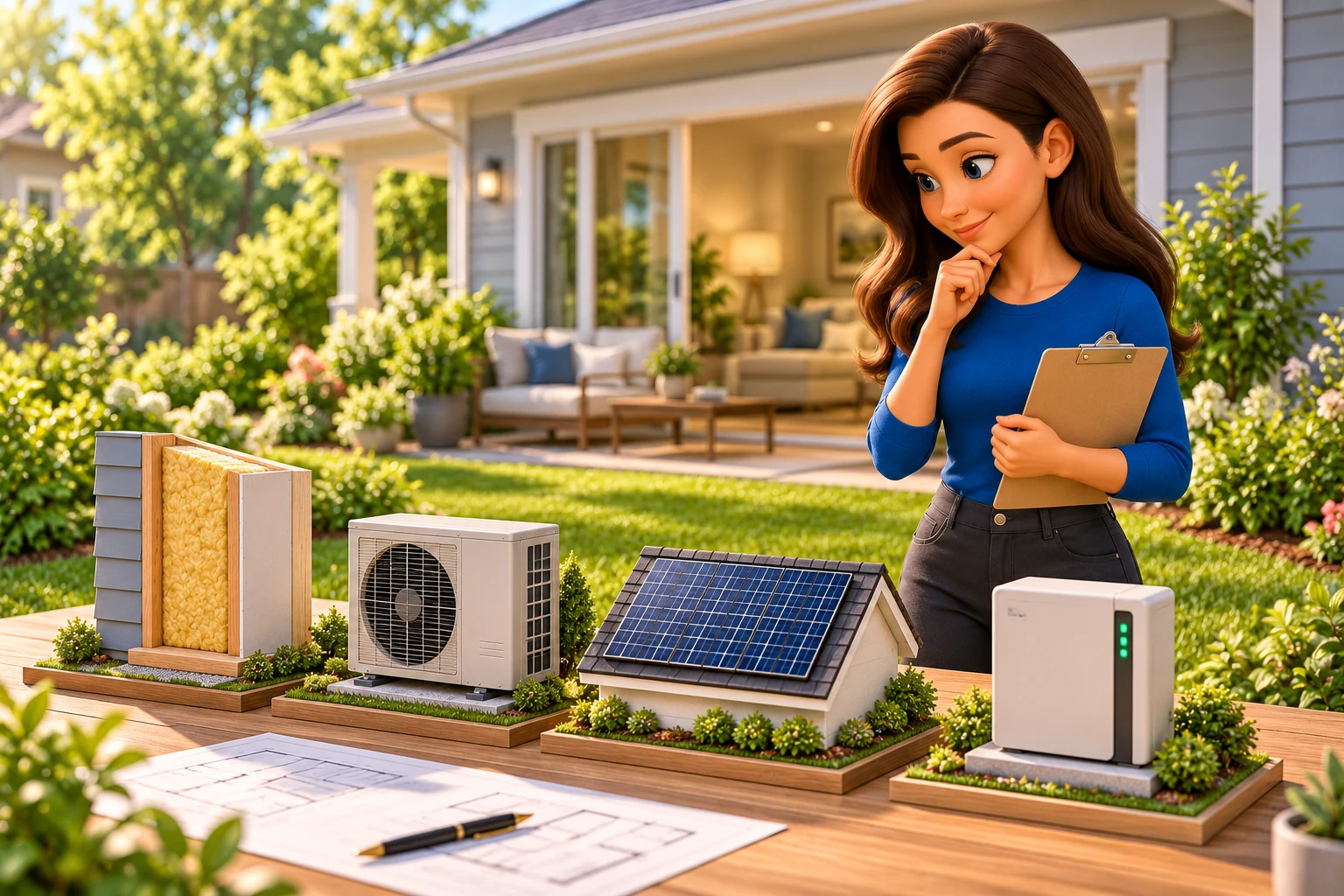
A useful home energy upgrade order starts with understanding your house and reducing avoidable demand. That usually comes before buying equipment or adding generation such as solar. A failed furnace, leaking roof or time-sensitive renovation can change the order. Plan around your home's condition and your deadlines.
Use this guide to decide what to do now, which jobs to coordinate and what can wait. It builds on the whole-home energy roadmap by explaining dependencies, meaning the work that needs to happen before another step.
Separate urgent work from optional improvements
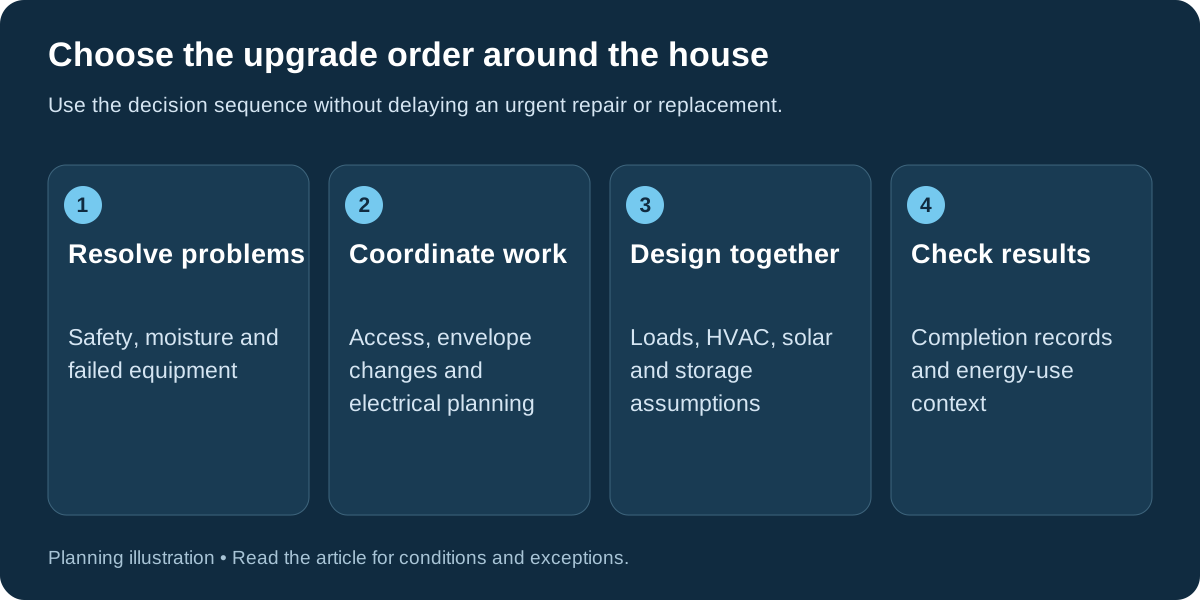
Make three lists: safety or building-durability problems, systems nearing replacement and optional improvements. Deal with immediate hazards and active water problems before covering them with insulation. Check unreliable equipment before planning new projects around it.
Then identify the decision deadline. If your home is comfortable and the HVAC works reliably, you have time to assess it and plan improvements to insulation, air sealing and other parts of the building envelope. A home without adequate heating or cooling may need a replacement immediately. Write down what needs to happen now and which improvements can wait.
ENERGY STAR’s Home Upgrade framework treats improvements as a coordinated set that homeowners can implement at their own pace. Use it as a planning model rather than a requirement to purchase every listed measure.
Reduce loads before final equipment sizing when practical
Tell your HVAC designer about any major work you plan on the building envelope, such as insulation or air sealing. Ask how it will change the heating and cooling loads. Be clear about which improvements you've committed to, what they include and when they'll happen. A possible plan to add insulation someday isn't a reliable design input.
Compare air sealing and insulation first, then determine whether duct improvements belong in the same project. Address ventilation and moisture as part of the design, not as an afterthought once the house is tighter.
Ask the designer which assumptions describe your house now and which describe it after the planned work. Those differences may affect equipment capacity, air distribution and controls. Insulation work won't always allow a smaller unit, and it doesn't automatically justify replacing a working unit early.
Compare three realistic starting situations
| Starting point | Suggested next steps | Decision to preserve |
|---|---|---|
| Serviceable HVAC; drafty rooms | Baseline, assessment, targeted envelope and duct work, then reassess replacement needs | Avoid locking equipment size before the planned building work is defined |
| Failed HVAC; limited time | Address immediate comfort needs, obtain a defensible design and identify future envelope work | Avoid an emergency purchase that ignores likely future loads or electrical requirements |
| Roof replacement planned; solar later | Coordinate roof condition, penetrations and future solar layout before finishing the roof project | Avoid paying to remove and reinstall equipment unnecessarily |
These are illustrative sequences, not diagnoses. In the first home, an energy assessment may reveal that an assumed insulation problem is actually duct leakage. In the second, installation quality and safe operation matter more than preserving a theoretical ideal order.
For the roof project, ask both trades to identify attachment, warranty and access requirements. Do not assume a roofer has designed the solar system or that a solar salesperson has assessed the roof’s remaining useful life.
Plan electrical capacity before separate equipment purchases
Prepare one future-load list for the electrician: heat pump, water heater, cooking equipment, EV charger, solar and storage where planned. A panel label alone does not establish whether your project needs a service upgrade.
Ask for an evaluation of existing service, available capacity, circuit requirements and any appropriate load-management options. Each option must fit the equipment, adopted requirements and utility rules. Avoid buying a charger or appliance on the assumption that any spare breaker space proves sufficient capacity.
You can prepare for a project without installing everything now. Planning a pathway, equipment location or future access may help with a later purchase. Get the requirements in writing from the right trades before you close walls or restore landscaping.
Plan the vehicle-specific charging need, parking arrangement and electrical assessment with the home EV charging guide before choosing a charging unit.
Once equipment is installed, use a daily home energy management schedule to coordinate solar, battery, heat-pump and EV charging priorities.
Place solar and batteries around your future needs
When the goal is energy-bill reduction, solar sizing should account for the household you are planning, not just the bills you had before efficiency work or electrification. Our energy-bill guide explains why net purchases alone may not show all household consumption.
A battery may move earlier in your plan if backup power is the main goal. List essential loads and the runtime you need. Then ask which combination of storage, generation and load control can support them. A resilience project needs a broader comparison than the energy payback alone.
Request assumptions about usable energy, output power, reserve settings and outage operation. A proposal should make clear which circuits are supported and what happens when demand exceeds the design. Equipment compatibility and approval must be confirmed for the actual installation.
Use the solar sizing worksheet for a heat pump and EV to compare current and future electricity scenarios before fixing the array size.
Use the home battery storage guide to define backup and bill-management goals before requesting a storage quote.
Compare bundled and staged quotes fairly
Ask for a base scope, optional measures, exclusions and dependencies. If a contractor presents a bundled price, find out what changes when one measure is postponed. Include restoration, permits and completion testing in comparisons where applicable.
Separate savings estimates may overlap, so don't assume you can add them together. Once you reduce the building's load, there's less energy use for more efficient equipment to save. Check any rebate or tax benefit with the program that administers it. Confirm the rules, timing and eligibility before deducting it from the cost.
Make a one-page dependency list. For each item, finish this sentence: “This work needs to happen before that purchase because…” Ask your project team about any gaps. Keep your overall goal in view as you work out the order.
Choose priorities when the budget cannot cover everything
Give each proposed measure a reason to proceed: safety, necessary repair, comfort, operating cost or future readiness. Then record the evidence, timing constraint and dependency beside it. A project that protects the building may take priority even when another option has a more attractive estimated energy payback.
If the scope remains uncertain, fund the investigation that could change the purchase decision. A home energy audit can be more useful than choosing between competing insulation and HVAC proposals that start with different assumptions. Ask the assessor and contractors which recommendations overlap so you can compare a staged plan with a bundled one.
Build the full budget and compare replacement options with the home energy upgrade costs guide before choosing which stage to fund.
Conclusion
Choose an upgrade order that fits your home's condition, your goals and the time you have. Handle urgent problems first. Coordinate jobs before access becomes difficult, and tell equipment designers which improvements you intend to make.
Keep planning your next step: read more in our Energy Efficiency category for guidance on reducing demand and choosing home energy improvements.

Scott Harding
Scott is the main author of DIY Home Comfort. Learn more about the team and our approach on the About page.