Home Energy Audit: What to Test and What the Report Should Include
Learn what a home energy audit should include, how to prepare, which tests to ask about and how to turn the report into a practical upgrade plan.
A home energy audit looks at how your house uses and loses energy. A useful assessment combines measurements with observations and gives you a written improvement plan. It should explain what to do, what you can leave alone and which problems need attention before work starts.
Choose the service around the question you need answered. A utility walkthrough may spot basic opportunities. A diagnostic assessment uses more detailed investigation to look into ongoing comfort problems or plan major heating, ventilation and air conditioning (HVAC) work or improvements to the building envelope, such as insulation and air sealing. Ask what's included; the service name alone won't tell you.
Choose the assessment around your decision
Before calling providers, write down the decision you need help with. Should you insulate the attic? Why is one room hot? Does a replacement heat pump need the same capacity as the current system? Send your question when asking what the assessment includes and what it costs.
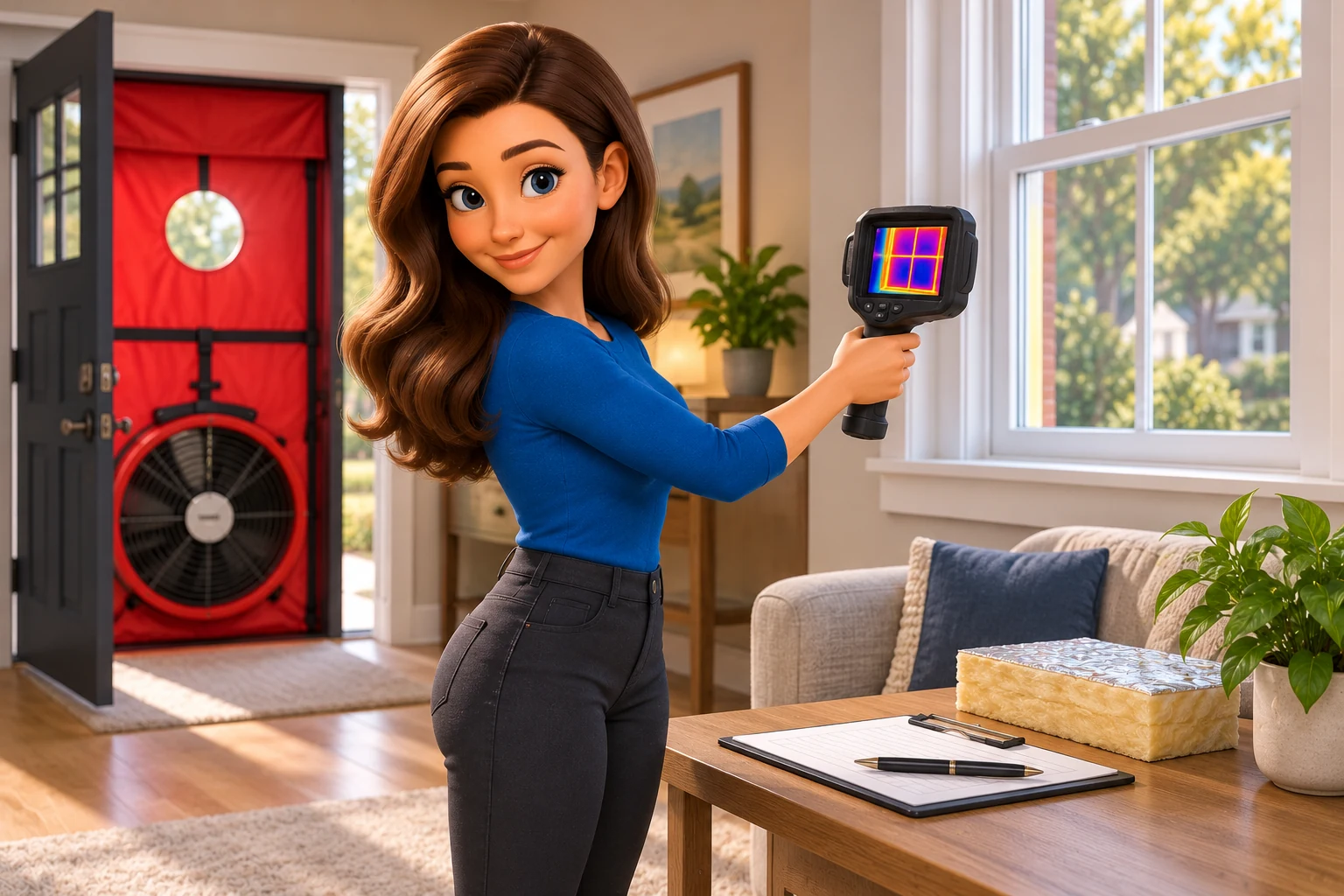
The Department of Energy’s home energy assessment guide distinguishes homeowner observations from a more detailed professional evaluation. Equipment-based testing may include a blower door, infrared imaging and duct-leakage testing. Confirm availability and suitability for your house before booking.
Ask whether the provider also sells installation work. Can you keep the assessment findings if you hire another contractor? What written report will you receive? An assessment fee pays for investigation; an installation estimate prices the work. A low-cost visit may not include a full assessment.
Prepare bills and a comfort diary
Gather a year of available electric and fuel bills, equipment service records and information about additions or renovations. Our energy-bill worksheet helps separate usage from rates and unusual billing periods.
Make the house’s patterns visible. Instead of “upstairs is always hot,” record “west bedroom becomes uncomfortable after 3 p.m. on sunny days; other upstairs rooms are acceptable.” Note whether doors are open, shades are closed and the system runs continuously. These observations give the assessor a possible explanation to check.
- Identify condensation, roof leaks, odors or areas with visible damage.
- Describe thermostat settings and how the home is normally occupied.
- List planned equipment, EV or major appliance changes.
- Tell the provider about combustion appliances, fireplaces and known hazardous materials.
- Ask how to prepare the building and appliances safely for the scheduled tests.
🛑 Do not create your own depressurization test by running exhaust fans or manipulating combustion appliances. Let the assessor control diagnostic conditions and safety procedures. Keep preparation limited to accessible observations and the instructions provided for your visit.
Understand what the measurements can tell you
Key Distinction
What A Blower Door Measures
Air LeakageA blower-door test measures air leakage under a controlled pressure difference. Ask for the result, units and test conditions. CFM50 reports air leakage in cubic feet per minute at the test pressure. ACH50 expresses it as air changes per hour for your building's volume. Neither number directly measures annual energy savings.
Infrared images show surface-temperature patterns. A cold patch may be worth investigating, but the image alone doesn't prove there's missing insulation or a water leak. Ask what conditions affected the scan and what other evidence supports the explanation.
Duct testing checks a different part of the system. Ask whether the test measures total leakage or leakage to outside conditioned space, and how that distinction affects the recommendation. Our duct diagnosis guide explains why an airflow problem should not automatically become an insulation quote.
Ask for a report that can become a work scope
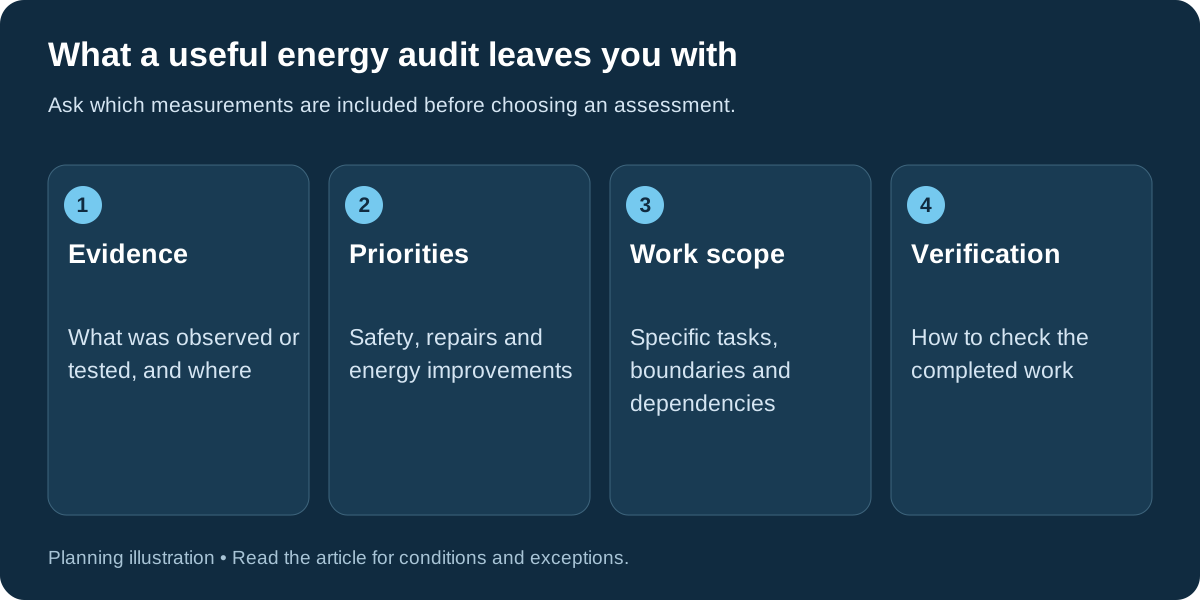
You should be able to follow the reasoning in the report. Each finding should name the location, explain the problem, suggest an action and say how to check the finished work. Ask for useful photographs and measurements. A colored score or product list doesn't give you the same information.
| Report item | Question it should answer |
|---|---|
| Observed condition | What was found, and where? |
| Evidence | Which measurement or observation supports it? |
| Recommended work | What exactly should the contractor include? |
| Dependencies | What repair or safety work comes first? |
| Expected outcome | Is the benefit energy, comfort, durability or a combination? |
| Acceptance check | How will successful completion be demonstrated? |
For example, “improve attic” is not a scope. An illustrative report entry might identify an unsealed hatch, describe the proposed durable air seal and insulation treatment, and specify how the assessor or installer will inspect the finished condition. The exact materials and clearances still belong to the qualified project team.
Make safety and ventilation part of the plan
Energy work changes how air and moisture move through your home. Ask how each improvement affects combustion appliances, exhaust systems, outdoor-air ventilation and moisture control. Those connections matter even when the savings estimate looks good.
PNNL’s home-performance assessment framework puts safety and durability within the whole-house evaluation. Use that principle when comparing providers: you want an explanation of interactions, not a blanket instruction to seal every visible opening.
If insulation is recommended, ask how the contractor will resolve air leakage first and preserve required ventilation pathways. The air-sealing comparison and attic guide explain the decisions in more detail.
Turn the findings into a realistic sequence
Sort the report into problems that need attention now, improvements to coordinate and optional projects for later. Get itemized quotes for the same work. Ask which savings estimates overlap and which depend on changing your household's habits.
A report may recommend several measures without requiring all of them this year. Use our upgrade-order guide to handle budget limits and urgent replacements. Retain the report so future contractors understand what was tested and what remains unresolved.
After installation, request the agreed completion checks and keep the results with your bills. Return to the home energy efficiency roadmap when the next decision comes up. The audit earns its value by changing decisions and verifying work, not simply by producing a document.
Common home energy audit questions
How much does a home energy audit cost?
Request a quote for the actual scope rather than relying on a national price alone. A walkthrough, a diagnostic visit with testing and a larger assessment with modeling can have different costs. Ask which tests, written findings, travel charges and follow-up checks are included. Check whether your utility offers an assessment program before booking; availability and eligibility vary.
Can I do a DIY home energy audit?
You can record bills, comfort patterns and safely accessible conditions yourself. These DIY observations help you prepare. Professional leakage measurements, combustion checks and investigations inside hidden assemblies need the right expertise. Use the report checklist above to decide when you need diagnostic help.
How do I choose an assessor?
Ask about relevant training, credentials, experience with your type of home and the diagnostic work included. Verify any claim that the assessor is certified with the issuing organization. Ask for a sample report and find out whether recommendations are independent of purchasing installation services.
Conclusion
A useful home energy audit gives you findings you can act on. You should know what evidence supports the problem, what work is needed, when it should happen and how to check it. Choose an assessment around your questions, then use the report to compare proposals.
Ready to turn the findings into a plan? Keep reading our Energy Efficiency articles for help evaluating the improvements that fit your home.

Scott Harding
Scott is the main author of DIY Home Comfort. Learn more about the team and our approach on the About page.