ERV vs HRV: Ventilation, Moisture and Choosing a System
Compare ERV and HRV heat and moisture transfer, understand drainage and humidity limits, and plan balanced ventilation and commissioning.

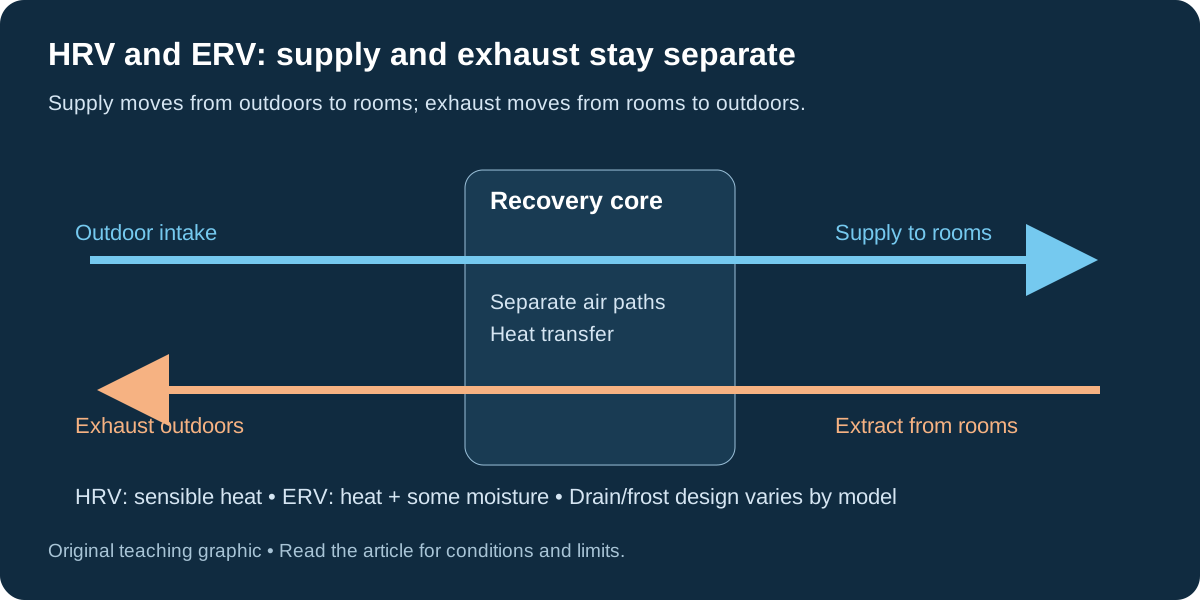
An HRV exchanges heat between outgoing indoor air and incoming outdoor air. An ERV also transfers some moisture through its core. Both provide ventilation through separate air streams; neither replaces source control, required local exhaust or a complete humidity-control plan.
What is recovered?
| System | Main exchange | Important limit |
|---|---|---|
| Heat-recovery ventilator, HRV | Sensible heat | Incoming-air moisture largely follows outdoor conditions; drainage may be required |
| Energy-recovery ventilator, ERV | Sensible heat and some moisture | Moisture transfer depends on conditions and core performance; it is not guaranteed dehumidification |
In humid cooling weather, an ERV can reduce incoming moisture compared with bringing in the same outdoor air without latent recovery. In dry winter weather, it can retain some indoor moisture that would otherwise leave. That can help or hinder the household's humidity needs.
The HVI whole-house ventilation guide explains these system distinctions. Choose by climate, occupancy, moisture loads, airtightness and product performance, rather than home age alone.
Recovery efficiency is not whole-house savings
A recovery percentage describes performance under specified tests and airflow conditions. It is not the same as the percentage reduction in the home's total heating or cooling bill. Fan electricity, leakage, frost control, imbalance, climate and runtime affect the net result.
Compare certified airflow, sensible or total recovery metrics as applicable, fan power and cold-weather operation on a consistent basis. Do not interpret a core rating as a guaranteed indoor humidity, pollutant-removal percentage or payback.
Plan supply and exhaust paths
Outdoor air should reach the intended occupied spaces; stale indoor air should be exhausted from the designed locations. Intake and exhaust terminals need suitable separation, weather protection and access. A diagram should show two distinct flow paths, not imply that exhaust air is simply recirculated as fresh supply.
Connecting to a central air handler changes distribution and fan-control requirements. The installer should measure supply and exhaust flows and balance the system at its intended settings. Filters alone do not remove every pollutant; combustion safety, kitchen exhaust and moisture sources require their own attention.
Drainage and frost control are model-specific
An HRV can produce condensate and require a drain and trap. Many ERVs do not need the same drainage arrangement, but exceptions and climate limits exist. Do not reverse those general tendencies into a universal installation rule.
The NRCan HRV guide explains drainage, maintenance and operation. Its Canadian educational context does not establish U.S. local code compliance. Follow the installed product's drain, frost-protection and core-care instructions.
Operation and maintenance checklist
- Keep the designed airflow settings and boost controls documented.
- Service filters and clean permitted components by the exact instructions; not every core can be washed.
- Inspect accessible outdoor terminals for blockage without unsafe climbing.
- Observe condensate and frost-control behavior and arrange service for leaks or persistent icing.
- Recheck balance after meaningful duct or control changes.
If indoor humidity remains high, investigate moisture entry, source exhaust, cooling performance and the need for dedicated dehumidification. An ERV is not a promise to hold a fixed relative humidity. Keep measurements in the temperature and humidity log.
For the next planning step, see air sealing vs insulation.
Conclusion
Choose an ERV or HRV using climate, moisture loads and verified airflow, then commission the entire ventilation path. Use our HVAC energy-efficiency guide to coordinate ventilation with heating, cooling and building improvements.
Continue with our heat-pump guides for related homeowner decisions.

Scott Harding
Scott is the main author of DIY Home Comfort. Learn more about the team and our approach on the About page.