HVAC Energy Efficiency: Equipment, Airflow and Installation
Improve HVAC energy efficiency by checking equipment ratings, airflow, ducts, controls and installation quality. Build a practical plan before buying upgrades.

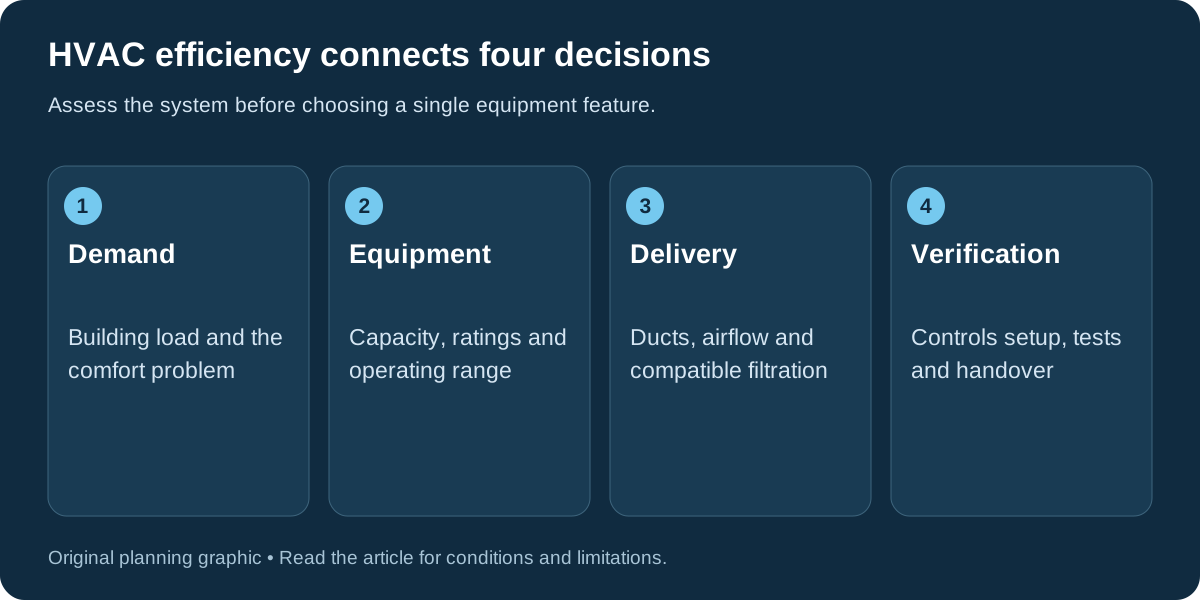
HVAC energy efficiency depends on your whole system. Your house creates the heating and cooling demand. The equipment meets it, while ducts, airflow and controls help deliver comfort to each room. Check how those parts work together before your next purchase.
This guide helps U.S. homeowners organize an existing-system assessment or replacement project. Start with the complaint you can describe, ask for evidence that explains it, and use the supporting guides below to compare specific decisions.
Start with the comfort problem and an energy baseline
Write down which rooms are uncomfortable, when it happens and what the system is doing. A hot upstairs bedroom in afternoon sun raises different questions from weak airflow throughout the house. A larger bill may reflect a rate increase, different weather or a household change rather than equipment deterioration.
Collect a year of available bills and service records. Use our energy-bill guide to separate usage from charges and billing days. Note changes such as an EV, added living space or longer occupancy. This creates a starting point; it does not isolate HVAC electricity use from everything else on the meter.
🛑 If the complaint spans the building and equipment, a home energy audit can help define the next investigation. Keep accessible photos and observations together without opening service panels or entering unsafe spaces.
Treat the equipment, building and distribution as one system
A highly rated AC won't reconnect a duct or block direct sun from a bedroom. Insulation work won't tell you whether refrigerant charge and airflow are correct either. Ask the assessor to separate the building load, equipment condition and air distribution findings in the proposal.
ENERGY STAR's quality-installation guidance identifies right-sizing, airflow, refrigerant charge and duct evaluation as important parts of installation quality. These are separate checks, not features automatically included by buying a premium model.
| Part of the system | Question to ask | Useful evidence |
|---|---|---|
| Building demand | What causes the heating or cooling load? | Home characteristics, comfort observations and load calculation |
| Equipment | What is its condition and rated performance? | Diagnosis, model numbers and matched-system information |
| Distribution | Can it deliver the intended airflow? | Duct findings, airflow and pressure measurements |
| Controls | Does setup match the equipment and household? | Documented configuration and operating demonstration |
Connect this work to the home energy efficiency roadmap. Where practical, tell the HVAC designer about planned improvements to insulation, air sealing or other parts of the building envelope before final equipment selection.
Compare ratings and capacity without confusing their jobs
Capacity tells you how much heating or cooling a system can deliver under specified conditions. An efficiency rating compares output with energy input under a defined test. More capacity doesn't mean better efficiency. Even the highest seasonal rating can't predict your household's costs by itself.
Our HVAC efficiency ratings guide explains SEER2, EER2, HSPF2 and AFUE. Ask for the exact indoor and outdoor model combination on the quote. Avoid applying a brand's advertised “up to” rating to a different combination.
Next, compare single stage and variable speed HVAC, including two-stage options. Ask separately about compressor or heating-output control and blower speed. Premium controls give you more ways to adjust operation. You still need suitable sizing, ducts and setup.
Protect airflow while addressing ducts and filtration
Keep accessible supply registers and return grilles clear of furniture and storage. Record weak airflow, unusual noise or a room problem that changes when its door closes. Those observations help a technician decide what to measure; they do not prove that a particular duct is undersized.
Use duct sealing versus duct insulation to separate leakage, heat transfer and airflow restrictions. These are different mechanisms, so “improve the ducts” needs a more specific scope.
Likewise, MERV rating and airflow belong in the same filter decision. Choose a correctly fitted filter within equipment limits rather than assuming the highest number is always suitable. If unused rooms are the concern, read whether closing air vents saves energy before trying to redirect air by shutting many registers.
Include controls, maintenance and moisture
Use settings your equipment supports and that fit your household. Ask how fan mode, staging and humidity controls work together. Leave installer settings to the technician. Check thermostat compatibility before upgrading, as well as the features you want to use.
🛑 ENERGY STAR's maintenance checklist separates several equipment-service tasks that affect operation. Request a written scope and findings. Follow manufacturer instructions for owner-accessible filter care; leave electrical, combustion and refrigerant work to qualified technicians.
When the house reaches temperature but stays damp, use the air conditioner versus dehumidifier guide. Cooling and moisture removal are related, but buying a larger AC or selecting a colder setpoint is not a diagnosis.
Compare repair and replacement, then agree on final checks
Compare a defined repair with a defined replacement scope. Include the condition of the indoor equipment, ducts and controls rather than pricing only the outdoor box. Our repair versus replace air conditioner guide provides a transparent cost framework without turning age into an automatic replacement rule.
Agree on the HVAC commissioning checklist before accepting a replacement proposal. Commissioning means checking and documenting how the installed system works. Ask which measurements you'll receive, what counts as an acceptable result and who will finish any follow-up checks.
For a broader equipment comparison, start with the existing guide to air conditioner types. For routine service planning, use the residential AC check guide alongside the current equipment manual.
Verify the work without promising a fixed savings percentage
Keep the completion records, filter specification, controls instructions and warranty documents together. Did the original room problem improve under similar conditions? Report new noise, moisture or operating concerns promptly so the installer can check them.
Compare energy use over a useful period. Note the weather, occupancy, thermostat settings and utility-rate changes. A lower bill alone doesn't show that every part of the installation meets its design. Keep the installation measurements alongside your longer-term operating-cost comparison.
For a heating and cooling replacement, compare heat pump upgrade choices using documented sizing, operating-range evidence and like-for-like quotes.
Conclusion
Build your HVAC efficiency plan around the problem you want to solve. Connect the building demand, equipment choice, air distribution and installation checks. Use measurements to choose the work and agree on what a successful result should look like.
Keep building your understanding: explore more Energy Efficiency articles for guidance on reducing demand and coordinating your next home improvement.

Scott Harding
Scott is the main author of DIY Home Comfort. Learn more about the team and our approach on the About page.