Does Closing Air Vents Save Energy? Airflow and Pressure Explained
Does closing air vents save energy? Learn how registers, duct pressure and airflow interact, and compare safer ways to address an uncomfortable unused room.

Does closing air vents save energy? In a typical whole-home forced-air system, it isn't a reliable way to save. Closing supply registers changes air distribution and the resistance the equipment works against. It may not reduce your home's heating or cooling demand enough to help.
One accidentally closed register doesn't prove your system is damaged. But before changing how you condition an unused room, check airflow, pressure, building conditions and controls. Fewer open vents won't necessarily mean a smaller bill.
Identify the supply register and return path first
🛑 Supply registers deliver conditioned air to rooms. Return grilles provide a path back toward the air handler. A room door can also affect the return route where there is no adequate transfer path. These components have different functions; do not block a return grille to imitate closing a supply register.
Keep accessible grilles clear of furniture, rugs and storage. Record which room is uncomfortable, how its door is positioned and whether the complaint changes by time of day. Ask the technician to identify the actual supply and return arrangements if you are unsure what a grille serves.
The HVAC energy efficiency hub explains how distribution fits with building load and equipment. A room problem needs that wider view before making a permanent change.
Understand what changes when a register closes
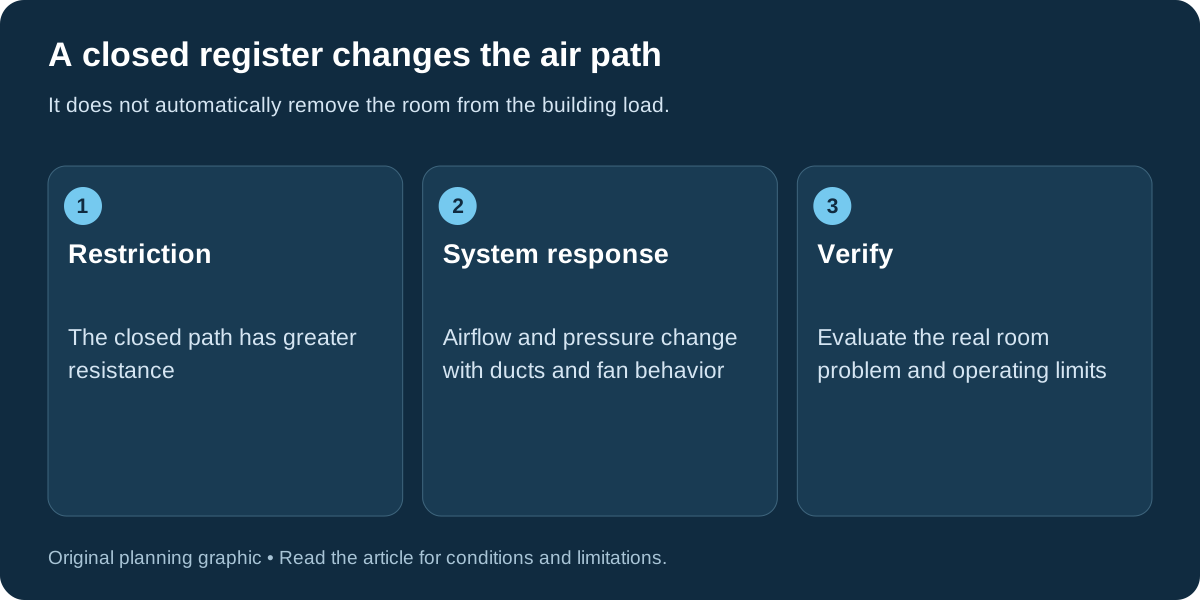
Closing a register increases resistance in that path. What happens next depends on your duct layout, leakage, blower and controls. Some air may move elsewhere. You can't assume it will reach the room you want or that the total delivered airflow will remain acceptable.
A Lawrence Berkeley National Laboratory register-closing study combined laboratory measurements and modeling. Under the house and duct conditions studied, added distribution losses offset reduced room-conditioning loads. The result supports caution; it is not a measured savings or damage forecast for every house.
Some blowers can work harder within their operating range as resistance rises. Other fan arrangements may move less air. Ask what happens in your installation and whether it stays within the equipment's requirements.
An unused room still exchanges heat with the house
The unused room is still part of your house after you shut the register. Heat keeps moving through its walls, floors, ceilings and door openings. Air can also move between rooms through designed paths and unintended gaps.
🛑 Moisture, plumbing protection and storage conditions may matter in an infrequently used room. Do not intentionally leave a space without suitable temperature or moisture control merely because nobody sleeps there. The right operating plan depends on the building and its systems.
If a room is hard to cool in afternoon sun, compare shading and other ways to reduce cooling load. If delivery is weak, review duct performance questions. These approaches investigate the mechanism instead of assuming the room needs more or less air from a nearby register.
Distinguish register closure from designed zoning
A designed zoning system coordinates controls, dampers, equipment and airflow provisions. The designer must account for operation when only some zones call for heating or cooling. Manually closing room registers doesn't reproduce that design.
If you're considering zoning, ask how the system will work when only a small area needs heating or cooling and when much more of the house needs it. Have the contractor explain capacity control, minimum airflow, pressure management and setup. Those details help you assess a room-by-room savings claim.
PNNL's pre-retrofit HVAC assessment guidance provides a broader assessment framework. Use it to ask whether the existing system and ducts support the proposed changes before purchasing control accessories.
Try observation and targeted corrections before restrictions
| What you notice | Useful next step | What it does not prove |
|---|---|---|
| Furniture covers a grille | Restore the required clear space | That the entire duct system is balanced |
| Problem changes when a door closes | Ask about the return-air path | That a larger AC is needed |
| One room gets afternoon sun | Document timing and assess heat gain | That closing another room's register saves energy |
| Whole-house airflow seems weak | Check permitted filter maintenance and request diagnosis | That every filter upgrade must be reversed |
| Unused-room zoning is desired | Compare a designed operating plan | That manual closures are equivalent |
🛑 Read the filter and airflow guide when a change began after installing a different filter. Keep a dated record of the product and observations. Do not remove required filtration or adjust installer fan settings to compensate.
Ask how the contractor will verify the change
For a balancing or zoning proposal, agree on the intended room conditions and equipment operating limits. Ask which airflow and pressure measurements you'll receive. Check which modes and zone combinations will be tested and what the contractor will do if the results aren't acceptable.
Do not copy a universal “safe number” of closed vents from the internet. The number of registers alone does not describe their size, duct layout or equipment. A limited adjustment directed by a professional for a particular system is different from recommending mass closure as an energy hack.
The HVAC commissioning checklist helps define the evidence for new or substantially changed equipment. If the system develops icing, repeated shutdowns or other unusual operation, arrange service rather than continuing a trial to see whether the bill improves.
Conclusion
Treat closing vents as a change to air distribution. Keep grilles clear and investigate the room problem you're trying to solve. If you want to change how the system serves your house, get a designed plan and have its operation checked.
Keep learning about practical alternatives: browse our Energy Efficiency articles for guidance on airflow, building improvements and HVAC choices.

Scott Harding
Scott is the main author of DIY Home Comfort. Learn more about the team and our approach on the About page.