Repair vs Replace Air Conditioner: Costs and Tradeoffs
Use this repair vs replace air conditioner guide to compare diagnosis, repair history, replacement scope and five-year costs with transparent assumptions.

Deciding whether to repair or replace your air conditioner starts with finding the fault. Then compare what a repair and a replacement would each include. Age, repair cost, comfort and energy use all matter. An inexpensive targeted repair is a different choice from another major repair on equipment that keeps failing.
This guide gives you a practical comparison worksheet and a deliberately hypothetical five-year example. Replace the example figures with written quotes and household-specific estimates before making a purchase.
Get a defined diagnosis before comparing prices
Ask what failed and what evidence supports the diagnosis. Will the repair fix the cause or just the symptom? Get the parts and labor scope, warranty and known limitations in writing. Ask whether anything else needs investigation.
🛑 If refrigerant loss is involved, ask how the source and repair options will be assessed rather than treating repeated top-ups as a complete plan. Leave refrigerant, electrical and internal equipment work to qualified technicians. A short invoice description may not provide enough information to compare a repair with replacement.
Use the residential AC check guide to organize service questions, then keep the actual technician findings with previous repair records.
Use age as context alongside condition and history
ENERGY STAR's replacement guidance identifies age, recurring repairs, comfort and operating problems as reasons to investigate options. Considering replacement is different from proving that every older system must be discarded immediately.
Record the equipment's age, maintenance history, recent failures and assessed condition, including corrosion. Ask about parts availability and what the contractor can't predict. Use the AC age guide to find identifying information. Treat any remaining-life estimate as uncertain.
A formula that multiplies age by a repair price cannot account for the diagnosed fault, replacement scope, household budget or access to service. It can prompt a discussion, but it should not replace one.
Make repair and replacement proposals comparable
A replacement quote should name the equipment combination, capacity, ratings and controls. Check that it lists duct work, required electrical work, disposal and any applicable permits or inspections. Ask what happens to the indoor components. An outdoor-unit swap may include much less than a complete matched-system installation.
Ask how the contractor will check the building load and existing distribution. The ratings guide explains why an advertised seasonal number does not verify an installed system. The commissioning checklist helps define which final checks and records the replacement price includes.
Keep financing charges, ongoing service agreements, exclusions and warranty terms visible. Do not deduct an assumed rebate or tax credit from the comparison; use only benefits for which you have current, verified eligibility and timing.
Compare a five-year example with explicit assumptions
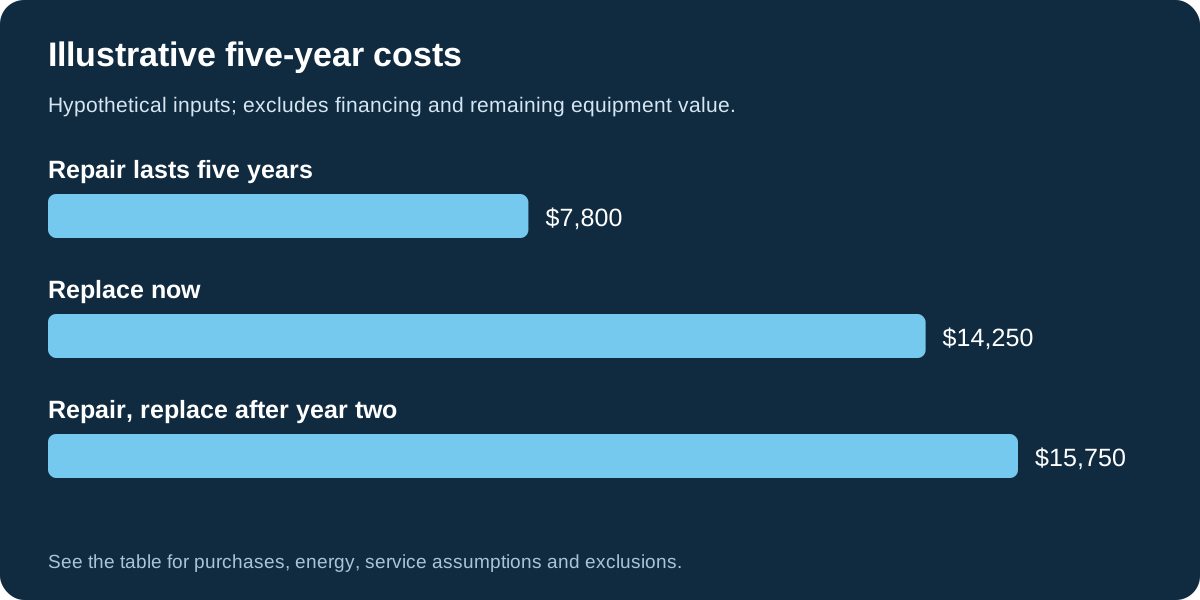
Illustrative arithmetic only, not market prices or an energy forecast. Assume a repair costs $800, a complete replacement costs $9,000, and annual cooling-energy spending is $1,200 for the repaired system or $900 for the replacement. Routine service is assumed to cost $200 or $150 per year respectively. All amounts are hypothetical dollars.
| Five-year cost | Repair lasts all five years | Replace now | Repair, then replace after two full years |
|---|---|---|---|
| Repair and replacement purchases | $800 | $9,000 | $800 + $9,000 = $9,800 |
| Cooling energy | 5 × $1,200 = $6,000 | 5 × $900 = $4,500 | 2 × $1,200 + 3 × $900 = $5,100 |
| Routine service | 5 × $200 = $1,000 | 5 × $150 = $750 | 2 × $200 + 3 × $150 = $850 |
| Total | $7,800 | $14,250 | $15,750 |
In the first case, repair costs less over this simplified period because we assume it lasts. In the third, you pay for both a repair and a later replacement, so it costs more. We haven't assigned a probability to either outcome. The scenarios show why remaining service life matters.
The example leaves out financing, inflation, discounting, other repairs and verified incentives. It also excludes resale or remaining equipment value at the end. It assumes the replacement costs the same when bought later. These totals aren't a complete life-cycle cost comparison, and the systems have different remaining life at year five.
Test the energy estimate instead of applying ratings to the whole bill
Ask how the contractor estimated annual cooling cost. Check the expected cooling use, proposed performance, applicable local charges, weather and thermostat assumptions. A SEER2 comparison applies to cooling, so don't apply it to the whole household bill. Other loads and fixed fees may remain.
Our bill-baseline guide explains the distinction. If future occupancy or building improvements will change demand, include them in the scenario rather than using today's total without adjustment.
Lower operating costs alone don't show that a replacement will recover its purchase price while you own it. Comfort, reliability, noise or a planned equipment change may still make replacement worthwhile. Record those reasons separately from energy-savings estimates.
Make a decision record you can revisit
- What exact fault does the repair address?
- Which other conditions or likely future work remain uncertain?
- What complete replacement scope has been priced?
- What happens if the repair lasts one, two or five more years?
- How much disruption and outage risk can the household accept?
- Which comfort, service or noise benefits matter beyond energy spending?
- What cost can the household fund without overlooking financing terms?
🛑 If replacement is likely, compare staging options and coordinate the work using the upgrade-order guide. Do not postpone an urgent safety issue while optimizing optional savings.
The HVAC efficiency hub brings equipment condition together with airflow, controls and the building. A replacement proposal should explain how it addresses the original problem, not merely provide a newer model.
Conclusion
Compare a diagnosed repair with a complete replacement scope. Try more than one remaining-life scenario. Keep uncertain savings and future service assumptions visible so you can choose around your home, budget and priorities.
Keep evaluating the next step: explore our Energy Efficiency articles for guidance on HVAC selection, installation and reducing demand.

Scott Harding
Scott is the main author of DIY Home Comfort. Learn more about the team and our approach on the About page.