Single Stage vs Variable Speed HVAC: Which Fits Your Home?
Compare single stage vs variable speed HVAC, including two-stage systems, comfort, controls, duct requirements and how to judge an installed-price premium.
Single-stage and variable-speed HVAC systems differ in how they respond when your home needs more or less heating or cooling. First, check which part the quote is talking about. Compressor modulation (adjusting its output), furnace heating stages and indoor blower speed are different features.
Start with a correctly sized system and the comfort problem you want to solve. Then compare the operating range, controls, ducts, installation work and extra cost. A premium label alone can't promise a set percentage off your energy bill.
Define single-stage, two-stage and variable operation
| Cooling arrangement | Basic behavior | Question for the quote |
|---|---|---|
| Single-stage compressor | Runs at one main cooling capacity when called to operate | How does its selected capacity match this home? |
| Two-stage compressor | Offers lower and higher cooling stages | What enables staging, and how is each stage configured? |
| Variable-capacity compressor | Adjusts output across its supported operating range | What are the minimum and maximum outputs under relevant conditions? |
Carrier's compressor comparison explains these categories. Actual ranges and control behavior are model-specific, so do not assume every variable system can turn down equally far or operates continuously.
All three can be appropriate in the right application. Start by comparing like-for-like equipment scopes rather than a basic outdoor-unit swap against a premium package that also includes duct repairs and new controls.
Ask what “variable speed” describes
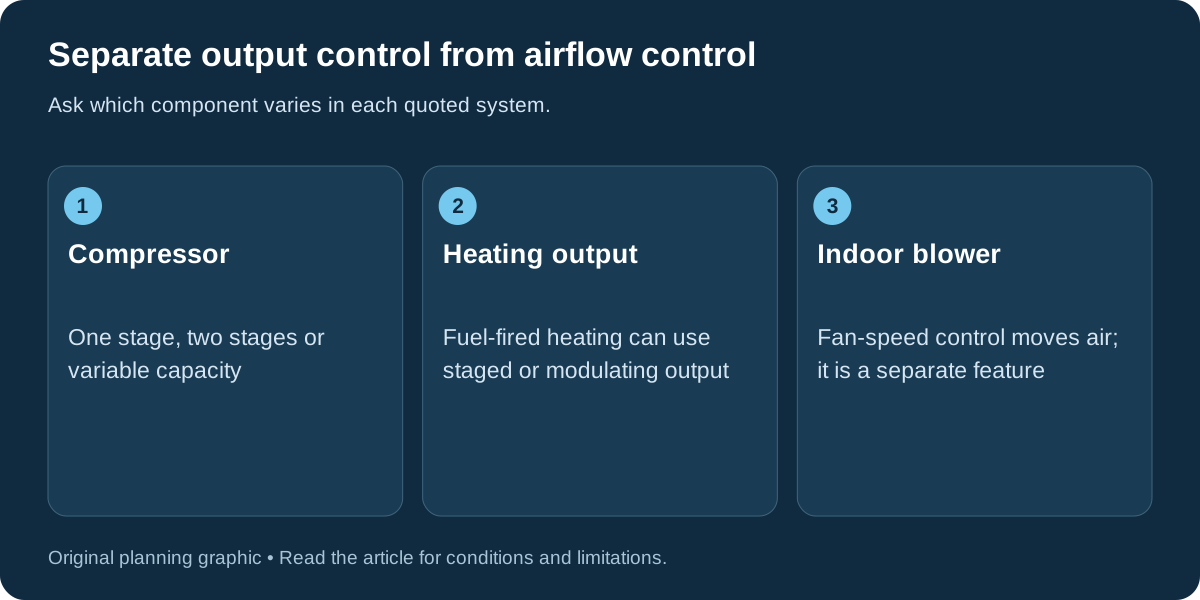
A variable-speed indoor blower changes how it moves air. A variable-capacity compressor changes cooling or heat-pump output. A two-stage or modulating furnace changes fuel-fired heating output. Your system may combine these features in different ways.
Carrier's furnace terminology guide distinguishes blower control from burner modulation. If a quote simply says “variable-speed furnace,” ask about both the heating-output stages and the blower rather than assuming it has fully modulating heat.
Ask the contractor to list the outdoor compressor, indoor fan, heating section and thermostat or controller separately. That makes it easier to compare the same features across quotes. One seller's blower upgrade may differ from another seller's compressor upgrade.
Connect the extra control to a comfort need
When your home needs less than maximum output, a suitable lower operating capacity can allow longer, gentler cycles. Depending on the equipment and setup, this may help keep temperatures steadier, reduce sound or improve moisture removal. Ask how those benefits relate to your specific room problem.
For example, an afternoon bedroom problem may come from solar gain or a restricted branch duct. Explain when the problem occurs and ask how changing the equipment's output would help with that problem. Use the HVAC energy efficiency hub to distinguish equipment, building and distribution questions.
If temperature is satisfactory but the house stays damp, compare AC and dehumidifier roles. Moisture control depends on more than compressor staging, especially when little sensible cooling is needed.
Keep load calculations and minimum capacity in the decision
Variable operation still needs correct sizing. If the lowest available output is too much for a mild-day load, the system may cycle on and off. It also needs enough capacity to meet the applicable peak load under the chosen design conditions.
Ask the designer to show the home-specific load calculation, equipment selection and performance information. For a heat pump, include low-temperature heating capacity and any backup strategy. Compare the proposed installation with planned insulation, air-sealing or window work before the design becomes final.
The home energy upgrade order guide helps coordinate those decisions. Do not delay an urgent replacement solely to complete optional improvements; instead, give the contractor the clearest available description of the intended home.
Check the ducts and controls before paying the premium
Ask whether your existing ducts can support the equipment across its operating range. A fan that changes speed can't deliver air through a disconnected duct. Have restrictions evaluated too, rather than assuming a stronger motor will overcome them.
Use the filter and airflow guide when filtration changes are part of the package. Ask whether the contractor will verify airflow and pressure with the filter you intend to use.
Check control compatibility for the exact equipment. Some systems need a particular communicating controller to use all their functions. Others support different controls. Ask which features each option provides, how replacement would work and how to operate it. A smart thermostat may not preserve every modulation or humidity feature.
Compare the installed premium against defined benefits
Compare proposals that include the same work: equipment combination, capacities, controls, duct work, electrical work, permits where needed, commissioning, warranty and maintenance. Ask how much of the price fixes an existing installation problem and how much pays for the staging feature.
| Proposed benefit | What makes it assessable? |
|---|---|
| Lower energy spending | A household-specific estimate with loads, rates and operating assumptions |
| Quieter operation | Comparable sound information and installation location |
| Steadier temperatures | A clear explanation of sizing, operating range and distribution |
| Better humidity control | Defined control capabilities and an assessment of moisture conditions |
| Longer-term ownership fit | Service availability, parts, warranties and control replacement options |
Comfort can justify spending even when a simple energy-payback estimate is weak. Keep that preference explicit. If the budget is limited, compare a well-designed basic system with necessary duct corrections before assuming premium equipment must come first.
Verify what was installed and enabled
Use the commissioning checklist to request model numbers, configuration, airflow checks and an explanation of how the system stages. Ask which modes were tested and what remains to be verified under different weather.
Record the selected filter and ask the installer to demonstrate normal thermostat operation. Keep the configuration documentation for future service. The ratings guide helps check that the purchased combination matches the advertised efficiency.
Conclusion
Choose the staging arrangement around your home's load, the equipment's operating range and your comfort needs. Check which component varies and whether the ducts and controls support it. Then decide whether the explained benefits are worth the extra cost to you.
Continue comparing the options: explore more Energy Efficiency articles for help planning an upgrade that fits the whole home.

Scott Harding
Scott is the main author of DIY Home Comfort. Learn more about the team and our approach on the About page.