Air Conditioner vs Dehumidifier: Cooling and Humidity
Compare an air conditioner vs dehumidifier for cooling and moisture control. Track temperature and humidity before choosing equipment or a colder thermostat setting.
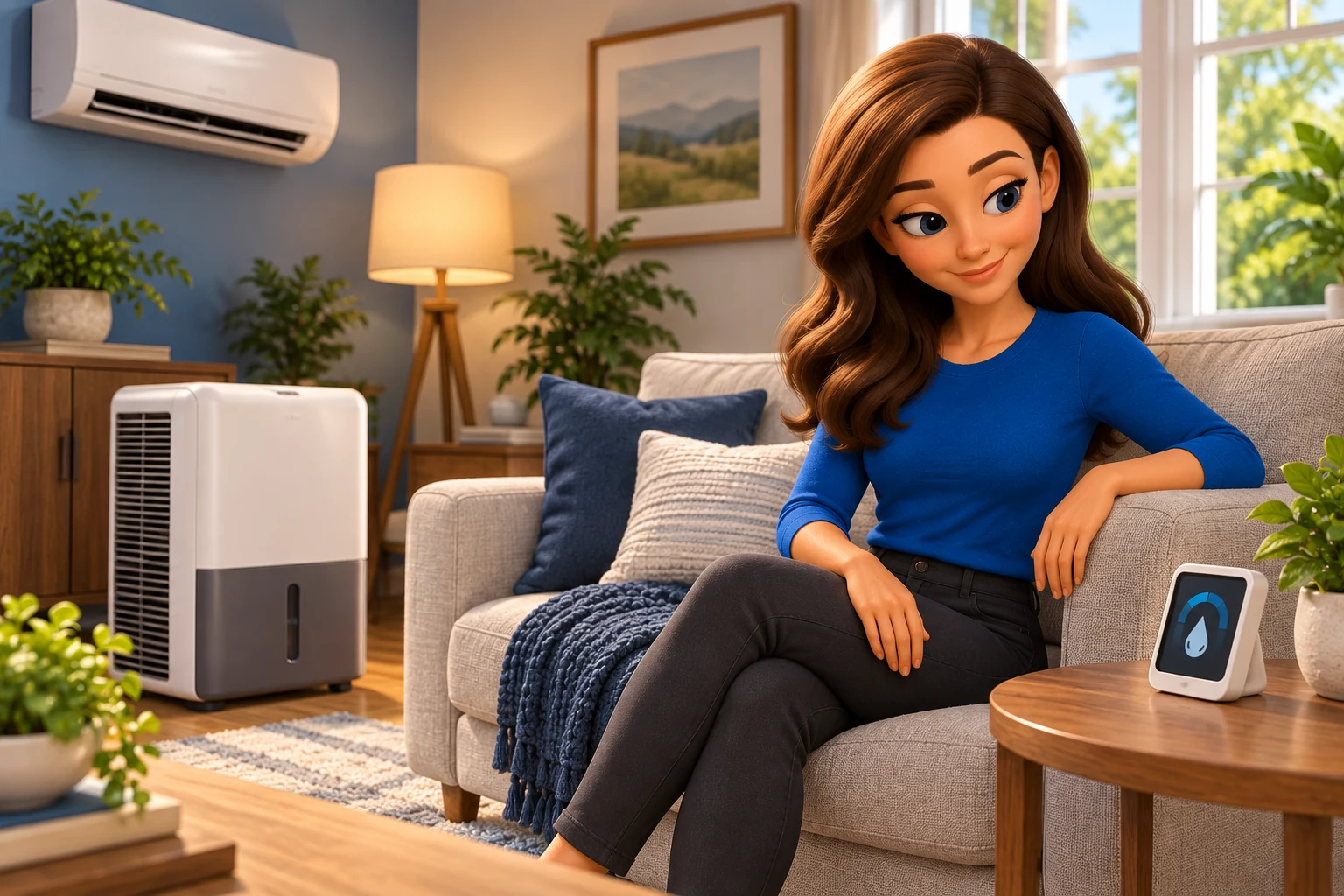
An air conditioner vs dehumidifier comparison starts with what your room needs. An air conditioner removes heat from the conditioned space and can remove moisture while cooling. A dehumidifier is built to remove moisture. A portable refrigerant dehumidifier releases heat into the room, so it won't cool it like an AC.
If a room feels clammy, record temperature and relative humidity before choosing more equipment or a colder thermostat setting. A moisture source, insufficient moisture removal and excessive heat gain need different responses.
Compare cooling and moisture removal as separate jobs
| Equipment | Main job | Important limit |
|---|---|---|
| Air conditioner | Removes heat from the conditioned space; may also condense moisture | Moisture removal depends on equipment, conditions, runtime and setup |
| Portable refrigerant dehumidifier | Condenses moisture and collects or drains the water | Adds heat to the room and uses electricity |
| Whole-home dehumidifier | Provides designed moisture removal integrated with the home | Needs suitable sizing, controls, drainage and installation |
ENERGY STAR's dehumidifier guide covers portable and whole-home options. Compare the type, rated water removal, operating conditions and drainage arrangement, not just room-area marketing.
A portable AC and a dehumidifier are also different appliances even if both collect condensate. Check the product's intended function and installation requirements rather than assuming a moisture-removal mode makes the machines interchangeable.
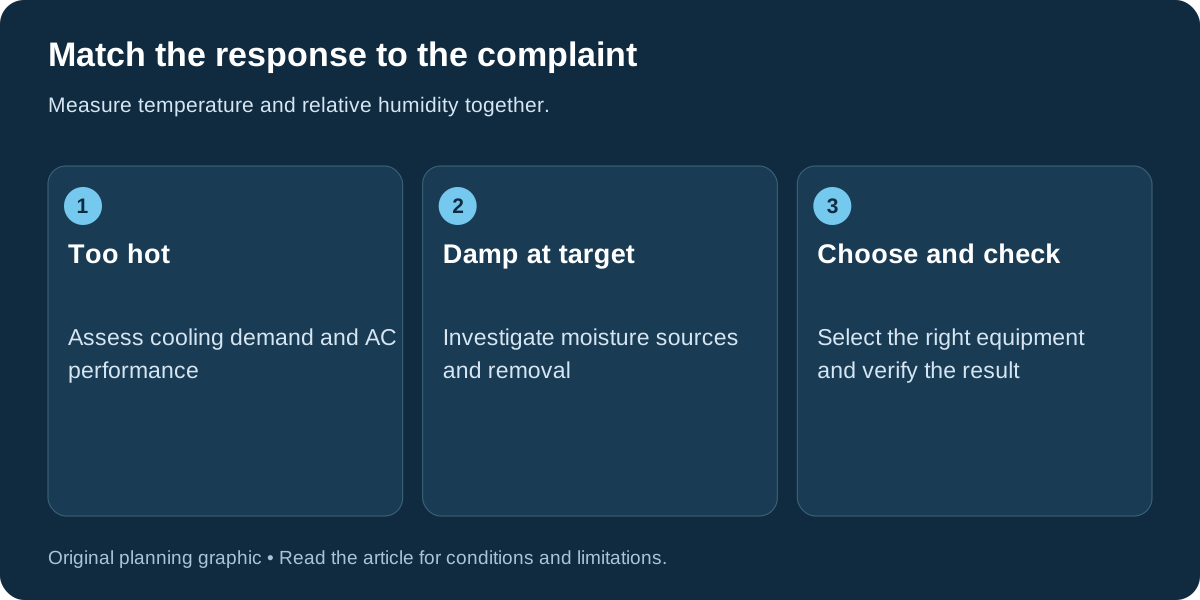
Measure paired temperature and humidity readings
Use a suitable hygrometer, a meter that measures humidity. Record the room, time, temperature, relative humidity, AC operation and relevant activities. Follow its placement instructions. Keep it away from direct supply air or a wet surface so the reading better represents the room.
EPA's home indoor-air guidance recommends keeping relative humidity below 60%, ideally around 30–50%. Treat that as general moisture guidance, not a universal thermostat or humidity-control setting for every building condition.
Relative humidity changes with temperature, so record both together. The same percentage at different temperatures doesn't mean the same moisture content. Take several readings in relevant conditions. A reading near a shower or just after a thermostat change may not show your home's usual pattern.
Open the printable temperature and humidity log. It includes spaces for activities, windows, equipment operation and notes to make the pattern easier to discuss with a contractor.
Look for a moisture source before adding capacity
🛑 Record plumbing or roof leaks, damp materials, drainage concerns and patterns around bathing, cooking or clothes drying. Ask whether exhaust systems discharge appropriately outdoors and whether their operation is suitable for the building. Do not enter an unsafe crawlspace or attic to investigate.
A dehumidifier may help room conditions, but it won't repair a leak. It also can't tell you whether wet materials are ready to cover. Arrange an assessment for persistent dampness or visible building damage before hiding the problem behind a new appliance.
The home energy audit guide helps frame a wider investigation. If air sealing or insulation is also proposed, use the envelope comparison to keep moisture and ventilation in the work scope.
Check AC sizing and operation without diagnosing by runtime alone
Your AC may reach the temperature setting before it removes enough moisture. Ask about oversizing, setup, airflow and building moisture loads. Short cycles are useful to report, but they don't prove a particular cause.
Ask the contractor to review the load calculation, equipment selection, airflow, drainage and humidity-control configuration. Get that assessment before buying a larger AC for dampness. Repeatedly lowering the temperature can leave the room too cold while the moisture source remains.
Use the commissioning checklist for the installation records. The staging comparison explains why modulation can be relevant but is not a universal cure for humidity problems.
Choose a dehumidifier around the actual space and operation
🛑 For a portable unit, compare rated moisture removal, intended operating temperature, sound, controls, clearances and the practical water-disposal method. Follow the product's electrical and placement instructions. Keep intake and outlet paths clear and avoid improvised drain arrangements that create leaks or trip hazards.
For a whole-home unit, request a designed installation scope covering its connection to the home, controls and drainage. Ask how operation interacts with the HVAC fan and whether the room-comfort complaint also requires separate work.
ENERGY STAR's dehumidifier criteria use integrated energy factor, or IEF. It measures liters of water removed per kilowatt-hour under the applicable test. A higher IEF helps you compare dehumidifiers tested alike. You can't directly compare it with an AC's SEER2.
Verify comfort, moisture and energy use together
Keep your log after making a change and compare similar conditions. Did humidity and the original problem improve? Are the added heat and noise acceptable? Can you manage drainage and maintenance? Water collected in the bucket is only part of the result.
When comparing operating cost, account for both the dehumidifier's electricity and any interaction with cooling. A plug-in energy meter may be useful only where the appliance and meter are suitable and their instructions allow it. Whole-system effects require a broader assessment; no fixed bill reduction is promised.
Connect the findings to the HVAC energy efficiency hub. If excessive summer heat is the main issue, start with cooling-load improvements rather than assuming moisture removal alone will provide the needed cooling.
Conclusion
Choose cooling equipment to remove heat and dehumidification equipment for a clear moisture need. Record temperature and humidity together, investigate moisture sources and check the results. A colder room isn't always a drier home.
Keep improving comfort with a clear plan: continue reading our Energy Efficiency articles on equipment, building demand and the next upgrade.

Scott Harding
Scott is the main author of DIY Home Comfort. Learn more about the team and our approach on the About page.