Heat Pump Water Heater Settings: Modes and Schedules
Understand heat pump water heater settings, hybrid and heat-pump-only modes, scheduling and vacation controls while following your model’s safety guidance.

Heat pump water heater settings control compressor operation, backup heating, stored hot water and scheduling. Choose a setup that safely meets your household's demand. Then make use of the efficient modes your exact model supports.
Find your installed model number and current owner manual first. Use this guide to understand the choices, then follow the guidance for your product and household. The heat pump buying guide connects these operating choices with your wider upgrade plan.
Understand what your model's operating modes actually do
You may see labels such as Heat Pump, Efficiency, Hybrid, Auto, Energy Saver, High Demand, Electric and Vacation. Similar names can work differently across products. Some units don't have resistance elements, and not every model offers every mode.
ENERGY STAR's operating overview separates compressor-focused operation, automatic backup, resistance heating and away features. Use those categories to read your manual, not to infer capabilities from a competitor's control panel.
| Mode category | Question to check in the manual |
|---|---|
| Heat-pump-focused | Is resistance heat prevented, limited or still permitted under exceptions? |
| Automatic or hybrid | When can backup operate to maintain hot-water delivery? |
| High demand | How does the mode increase recovery, and when should you return to routine operation? |
| Resistance only, if fitted | Is this intended as temporary backup or service support? |
| Vacation or away | What temperature, duration, return and freeze-protection behavior applies? |
“Hybrid” here commonly means heat-pump and resistance water heating. It does not mean that this appliance burns gas. Keep that terminology separate from a dual fuel space-heating system.
Choose an everyday mode that keeps up with hot-water use
Start with the manufacturer's recommended normal mode. Have the installer show you how it works. Then check whether your household has enough hot water during a normal day. Note the mode, approximate demand, unusual room conditions and alerts.
For example, Rheem's hybrid operating explanation describes Energy Saver, High Demand and Heat Pump operation with different recovery priorities. Those descriptions illustrate one manufacturer's approach; they do not establish settings for every brand or model generation.
If your model supports compressor-only operation and meets your demand that way, you may need less resistance heating. If you repeatedly run out of hot water, talk with the installer. Review mode, timing, capacity and installation conditions together rather than treating cold showers as proof of efficiency.
Make one owner-permitted change at a time, record it and allow a normal recovery cycle before comparing results. Frequent changes make it difficult to tell which condition caused the difference.
Respond to guests and cold conditions without hiding a fault
Consecutive showers, a bath or colder incoming water can change recovery needs. A cooler installation space may also limit compressor performance. Check your manual for the operating range and any automatic fallback behavior.
🛑 An available high-demand or automatic mode may be appropriate for a temporary increase in use. Set a reminder to reassess after guests leave, rather than leaving a temporary mode active indefinitely. Do not disable backup wiring or sensors to force compressor operation.
If hot-water availability changes under an otherwise familiar routine, record the alert or symptom and arrange service. A control adjustment cannot repair a leak, an obstructed air path or a failed component. Use our heat pump water heater sizing guide when the underlying delivery requirement has changed.
Treat temperature as a safety decision
🛑 A storage setpoint is not the same as the temperature delivered at a fixture. Household health risks, scald protection, installed mixing arrangements and the manufacturer's instructions all belong in the decision. There is no single temperature we can prescribe safely for every reader.
CDC's household water guidance explains the trade-off between controlling waterborne germs and preventing burns. It advises discussing Legionella risk with a healthcare provider and using appropriate thermostatic mixing measures when higher storage temperatures are used.
🛑 Have a qualified plumbing professional assess, install and verify any required mixing or temperature-limiting devices. A valve's presence alone does not demonstrate correct performance at all fixtures. Children, older adults and people with reduced temperature sensitivity need particular scald protection.
🛑 Do not copy a high-temperature “storage boost” routine from another household or reduce storage temperature aggressively to chase an app's energy number. Agree on a safe operating plan first, then evaluate efficiency within that plan.
Use scheduling to compare electricity cost and energy separately
A supported time-of-use schedule may move some heating into cheaper hours. First, check whether your actual electricity plan has time-varying rates. Read the seasonal hours and rules for weekends, holidays and programs. A generic off-peak schedule may not match your tariff.
PNNL's load-shifting research found that the amount of hot water used, incoming-water temperature, equipment and operating mode influenced results. Its tested systems and climate do not support a universal schedule or savings percentage for every home.
Hypothetical Example
One kWh At Two Prices
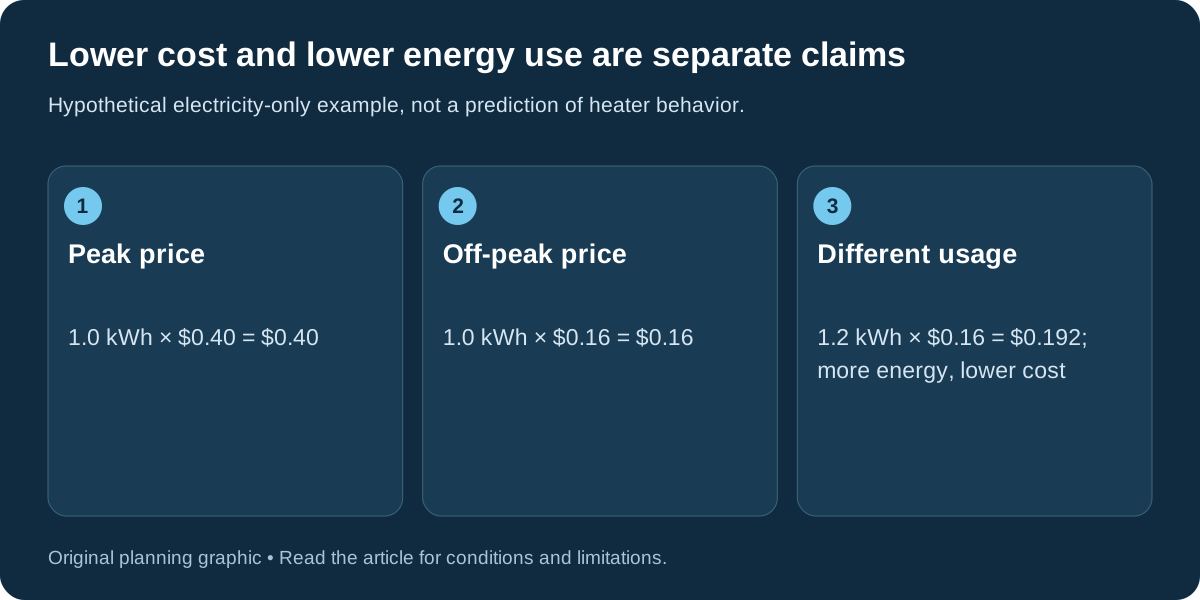
$0.24 DifferenceConsider this deliberately simplified electricity-price example. One kWh bought at $0.40 costs $0.40; the same one kWh at $0.16 costs $0.16, a $0.24 difference. If a hypothetical alternative instead uses 1.2 kWh at $0.16, it costs $0.192, or about $0.19. The arithmetic shows why lower cost and lower kWh are separate claims; it does not predict your heater's consumption.
🛑 Account for storage losses, backup operation and adequate hot water before judging a schedule. Use manufacturer-supported controls, retain safe temperatures and avoid an external timer that bypasses required controls. Our energy-bill guide helps separate usage, rate and fixed-charge changes.
Plan away mode and the return to normal use
Check your exact manual for away duration, maintained temperature, restart timing and freeze limitations. Vacation mode doesn't guarantee protection from frozen pipes. It also isn't a complete water-hygiene plan for a vacant home.
A Rheem model-family manual, for example, documents specific vacation duration and control behavior. Use it only for equipment it covers. Online summaries and manuals from another generation can differ.
Before a prolonged absence, ask your installer how to manage the equipment and plumbing safely, including return-to-use steps. If the home has vulnerable occupants or concerns about stagnant water, get appropriate health guidance as well. Do not assume that reaching a hot display temperature instantly resolves every stagnant-water concern.
Check results and keep the installation maintained
Keep a short log of settings, unusual demand, delivered-water complaints, available energy data and service alerts. Compare similar periods. Water-heater app figures may be estimates; they may differ from a dedicated revenue-grade meter.
🛑 ENERGY STAR's installation and maintenance guide highlights access, air-filter care and condensate maintenance. Follow the installed model's instructions and shutdown precautions for owner-accessible tasks; leave electrical panels, refrigerant components and plumbing safety devices to qualified personnel.
If the heater needs frequent high-demand operation simply to support normal use, request an assessment rather than changing more controls. For a replacement or corrective-work proposal, use the installation quotes guide to document responsibilities, final checks and owner instructions. For the underlying technology, revisit how heat pump water heaters work.
Conclusion
Match your settings to the product, your demand pattern and a safe installed temperature strategy. Establish reliable everyday operation first. Use supported scheduling where it helps, and compare electricity cost separately from energy use.
Keep exploring practical upgrades: read more Energy Efficiency articles on equipment selection, household energy planning and efficient operation.

Scott Harding
Scott is the main author of DIY Home Comfort. Learn more about the team and our approach on the About page.