Heat Pump Water Heater Sizing: Capacity and Placement
Plan heat pump water heater sizing around peak demand, first-hour rating, recovery and installation conditions. Check placement before choosing a tank.
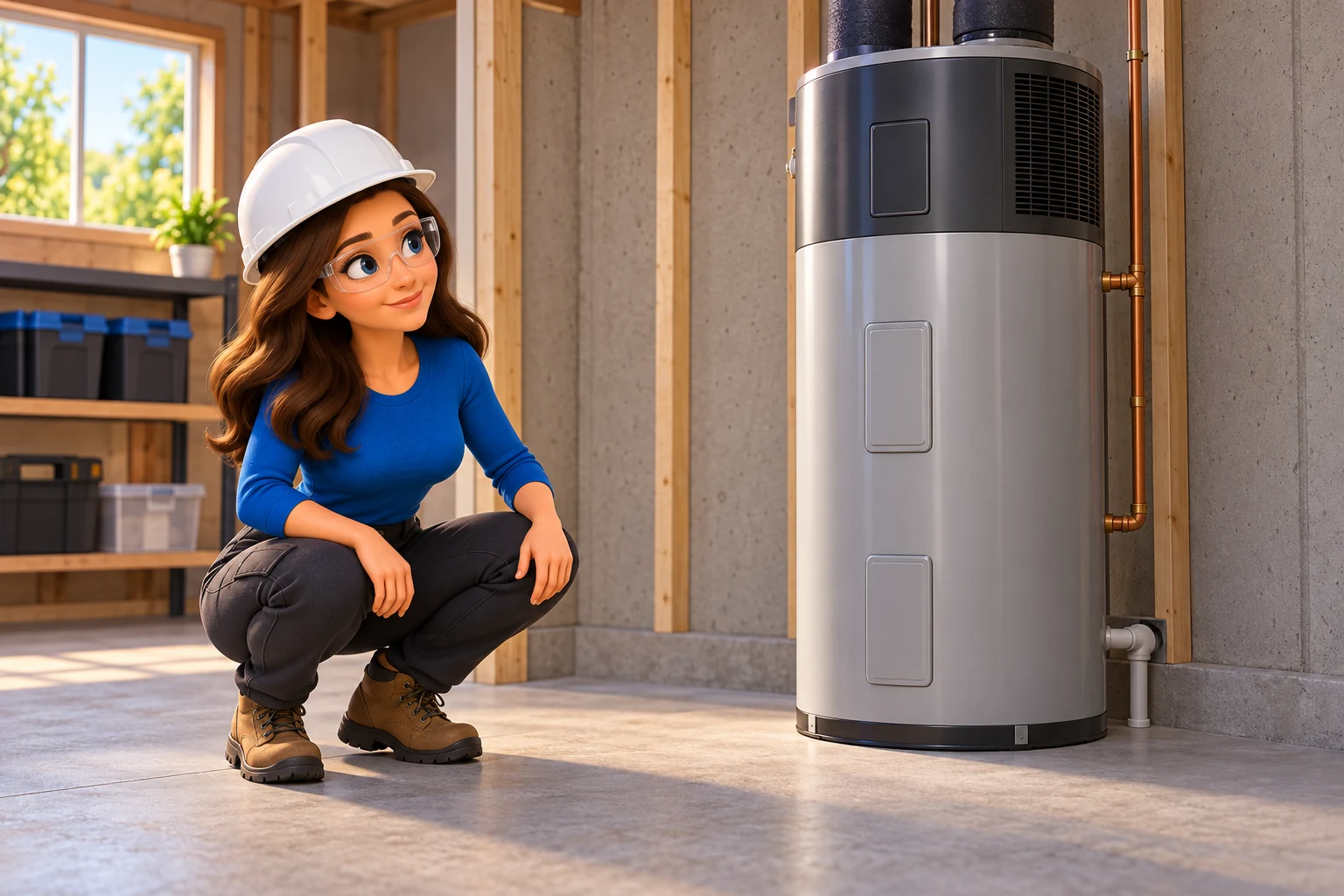
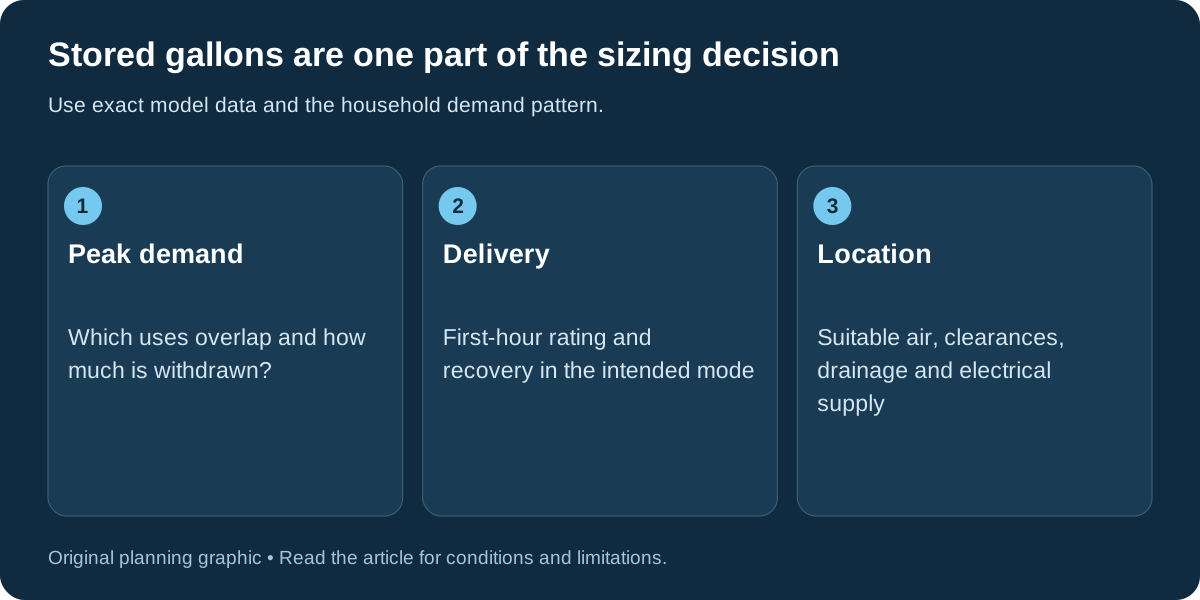
Heat pump water heater sizing starts with your busiest hot-water period. Household size alone won't tell you enough. The heater needs to store enough hot water and reheat it quickly enough between uses. Its location must also meet its exact air, temperature and service requirements.
This guide covers planning for a residential storage-type heat pump water heater in a U.S. home. Use it with our heat pump buying guide to organize the project, then have an experienced installer confirm the equipment and installation design.
Describe your peak hot-water demand
Write down when showers, baths, dishwashing and laundry overlap. A household taking several consecutive morning showers creates a different requirement from the same number of people spreading showers across the day. Include guests, a large tub and changes you already expect.
Use actual fixture information and the installer's demand estimate rather than assigning every person an identical gallon allowance. Shower water is normally a mixture of hot and cold water; its total flow is not automatically the volume withdrawn from the tank. Keep the measurement basis consistent.
Hypothetical Example
One-Hour Draw
41 GallonsFor an illustrative planning log, suppose two uses each withdraw 16 gallons of hot water from the heater, with another 5 gallons and 4 gallons used during the same hour. The assumed heater-side total is 16 + 16 + 5 + 4 = 41 gallons. These are invented inputs, not average shower allowances or a recommendation for a specific tank.
Bring that pattern to the installer. Also note how soon the next demanding period begins. An hourly total alone can hide a short, intense draw or a tank that has not recovered from earlier use.
Compare first-hour rating with tank volume
Nominal tank gallons describe a size category. Rated storage volume describes the actual amount stored under the applicable rating method. First-hour rating, or FHR, tells you hot-water delivery during a standardized hour starting with a fully heated heater. Both stored water and reheating contribute.
ENERGY STAR's product criteria and glossary distinguish FHR from the efficiency rating. Ask for both values for each exact quoted model. Two nominally similar tanks can have different first-hour delivery.
The illustrative 41-gallon demand log is a conversation starter, not proof that any product labeled above 41 gallons FHR will satisfy every condition. The installer should reconcile the estimate with applicable sizing requirements, draw timing, water temperatures and the selected operating mode.
Request the data sheet rather than accepting “suitable for a family of four.” If the proposed replacement is a different size from the old heater, ask what performance evidence supports the change.
Account for recovery, operating mode and colder conditions
Recovery is how the heater replenishes hot water after a draw. Heat-pump operation and electric-resistance backup, where fitted, may recover at different rates. The published FHR may not describe heat-pump-only delivery in your room and incoming-water conditions.
A. O. Smith's Voltex 120V product literature illustrates why replacing a gas heater with the same nominal tank gallons is not a universal sizing method. Its larger storage options are presented alongside their own first-hour ratings. Those comparisons apply to that product family, not every heat pump water heater.
Ask how the model performs with your coldest expected inlet water and installation-space temperatures. Colder incoming water needs a greater temperature rise to reach the storage setting. Air-source equipment also depends on the air conditions around it.
If minimizing resistance operation is important, have the installer evaluate storage and recovery in the intended mode. Our heat pump water heater settings guide explains the operating trade-offs. Do not assume every plug-in or hybrid model offers the same backup equipment.
Separate efficiency ratings from available hot water
Uniform Energy Factor, or UEF, measures efficiency under standardized conditions. It doesn't tell you tank gallons, guarantee recovery time or predict your electricity use. A higher UEF can't make up for inadequate hot-water delivery.
A. O. Smith's UEF explanation emphasizes comparing ratings within the same usage bin, or hot-water-use category. Record the bin and exact model when comparing products. Keep energy efficiency and adequate delivery as separate selection checks.
Compare three things on your short list: evidence the model can meet your delivery needs, applicable efficiency data and the installed scope. Remove unsuitable options first. Then compare price and advertised savings among the models that fit.
Check the room, air path and service clearances
Measure the proposed location, route into the house and overhead space. Have the installer check them against the exact manual. The tank needs a suitable air source as well as physical space. A closet wide enough for the tank may still need an approved air-transfer or duct arrangement.
ENERGY STAR's design guidance covers air availability, sound, cooler exhaust and model-specific installation requirements. It is a new-construction resource; use its planning questions with the actual replacement manual rather than treating a program table as a universal retrofit rule.
Ask where the cooler exhaust air will go and whether fan or compressor sound could affect a bedroom or workspace. If the heater takes heat from conditioned indoor air, discuss how that affects home heating and cooling. It won't automatically work as a whole-house dehumidifier or provide free winter heat.
🛑 Leave room to reach the controls, service connections and owner-accessible filter. Do not improvise ducting, enclose the air inlet or add a sound cover without the manufacturer's approval.
Include electrical, drainage and plumbing requirements
🛑 The heater's voltage and circuit requirements need a qualified electrical assessment. A plug-in product is not permission to use an extension cord or an unverified outlet. When changing from gas, have professionals evaluate safe fuel-system and vent decommissioning, including any shared venting.
Heat pump water heaters produce condensate too. Ask the installer to identify the approved drain route or pump arrangement and how they'll address leakage risks. Keep that separate from the safety relief-valve discharge requirements.
PNNL's heat pump water heater checklist brings together first-hour sizing, suitable clearances, drainage, safety provisions and commissioning. Use it to ask what the installation includes, with the current product instructions and applicable requirements taking precedence.
🛑 Have the installer assess expansion control and temperature-limiting measures where applicable. Tank temperature and delivered tap temperature are different design questions; do not raise the setpoint to disguise an undersized installation.
Put the selection evidence in the quote
| Request | What the answer should establish |
|---|---|
| Exact model, nominal and rated storage volume | Which product will actually be supplied |
| FHR, intended mode and demand assumptions | Why delivery should suit your peak pattern |
| UEF and usage bin | A meaningful efficiency comparison |
| Location and air arrangement | Compliance with the model's installation limits |
| Electrical, plumbing and drainage scope | Which associated work is included |
| Commissioning (setup checks) and owner instructions | How operation, settings and maintenance will be demonstrated |
Use the heat pump installation quotes guide for the broader comparison process. For background before choosing the technology, read how a heat pump water heater works and the existing pros and cons guide.
Conclusion
Choose a heat pump water heater that can meet peak delivery and recovery needs in a suitable location. Compare exact model data and ask how the intended operating mode changes performance. Include the associated installation work when you compare quotes.
Keep planning your next improvement: read more Energy Efficiency articles on equipment choices, energy use and coordinated home upgrades.

Scott Harding
Scott is the main author of DIY Home Comfort. Learn more about the team and our approach on the About page.