How Does a Heat Pump Water Heater Work?
Understand the refrigeration cycle, storage tank, backup elements and installation conditions that affect heat pump water heater performance.
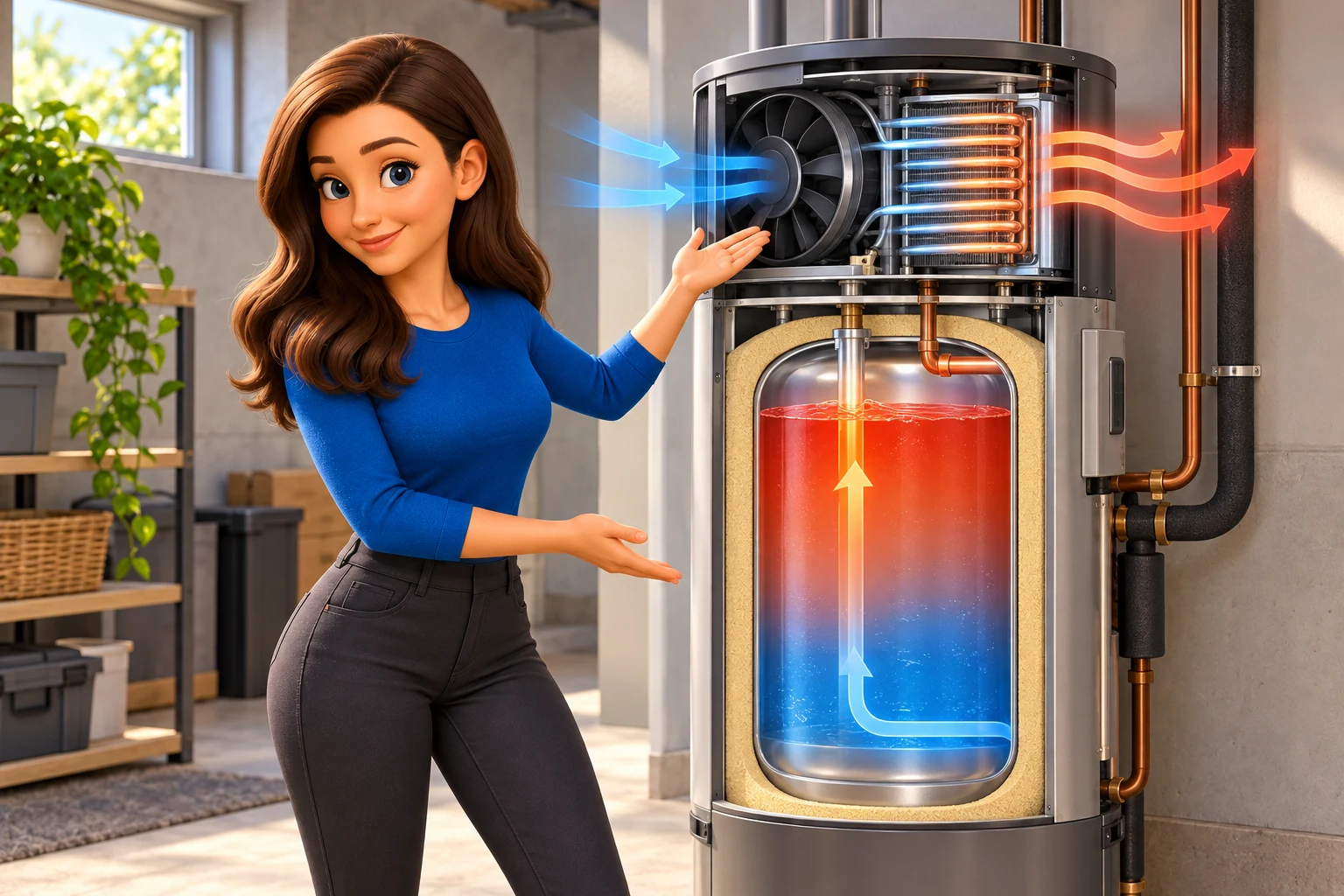
A heat pump water heater uses a refrigeration cycle to move heat from surrounding air into water. Electricity operates the compressor, fan and controls. Most integrated residential models store the heated water in a tank, and many hybrid models have resistance elements for additional heating.
That makes it different from both an ordinary electric resistance tank and a tankless heater. See heat pump water heaters pros and cons for the main buying tradeoffs.
The refrigeration cycle
- Collect heat: a fan moves air across the evaporator, where refrigerant absorbs heat.
- Raise temperature: the compressor raises the refrigerant’s pressure and temperature.
- Heat water: the hot refrigerant transfers heat through a condenser or heat exchanger into the stored water.
- Repeat: an expansion device reduces refrigerant pressure so the cycle can collect more heat.
The cycle transfers energy; it does not create it. ENERGY STAR explains why this can use less electricity than resistance heating.
🛑 The exact heat-exchanger arrangement varies. An integrated tank may use a refrigerant coil associated with the tank. Some split systems have separate components and water circulation. Do not assume every unit pumps household water through an external loop. Refrigerant and electrical servicing belongs to qualified personnel.
Storage, recovery and backup
| Term | What it means for the household |
|---|---|
| Storage volume | The amount held in the tank; it does not by itself establish usable delivery during a busy period. |
| First-hour rating | A standardized measure that includes stored hot water and recovery during the test. |
| Heat-pump-only operation | Prioritizes the heat pump where permitted; recovery depends on the unit and conditions. |
| Hybrid or automatic mode | May bring in resistance elements according to the manufacturer’s controls. |
There is no universal rule that a given household size requires one tank volume. Match peak demand, FHR, installation conditions and intended mode using our sizing guide. Running backup elements more often can change the expected energy savings.
Where the heat comes from
The surrounding air supplies heat, and the discharged air is cooler. Moisture can condense and needs an approved drain arrangement. A heater in conditioned space interacts with the home’s heating and cooling systems; winter heat extracted from that room is not automatically free.
Permitted ambient temperatures, room volume, ducting options and backup behavior differ by model. ENERGY STAR’s installation design guidance describes these considerations. Use the exact installation manual rather than one national room-size or outdoor-temperature rule.
🛑 A unit may use backup heat or limit heat-pump operation outside its allowed range. That is different from saying every heater becomes unusable in a cold climate. Sound from the fan and compressor also depends on the product and room; do not add a blanket that interferes with airflow.
Settings and safe delivery
🛑 The storage setpoint, delivered tap temperature and the heater’s operating mode are separate controls. A setpoint change can affect scald risk, microbial control, capacity and energy use.
CDC’s guidance for home water systems discusses 130–140°F [54–60°C] for water-heater settings to help control germs, with burn-protection measures when settings exceed 120°F [49°C]. Do not turn those figures into a universal instruction. Follow the equipment requirements and seek advice about household health needs and suitable thermostatic mixing devices.
Vacation modes are also product-specific; some maintain a reduced temperature, while other controls work differently. Read our settings guide and the installed manual before making changes.
Maintenance and efficiency
- Keep the air path clear and clean the filter if the model has one.
- Check the specified condensate route and signs of leakage.
- Follow the tank, anode and relief-device maintenance schedule.
- 🛑 Arrange qualified service for recurring faults, electrical work or refrigerant problems.
Heat pump water heaters still have storage-tank maintenance needs. Neither the technology nor a warranty establishes a guaranteed lifespan. For efficiency comparisons, use the model’s Uniform Energy Factor within the relevant usage bin; A. O. Smith explains the UEF system.
Costs and current incentives
Estimate cost using the actual model, selected mode, electricity tariff, household demand and complete installation scope. A published savings example does not establish what every home will save, and electricity-supply emissions affect any carbon comparison.
Do not budget the former federal home-improvement credit for equipment installed in 2026. The IRS eligibility period ended December 31, 2025. Utility and local programs need a separate current eligibility check.
Conclusion
A heat pump water heater transfers heat into stored water, often with backup resistance heating. Its results depend on the model, demand, controls and installation environment. Browse our water heater guides to compare capacity and practical installation requirements.

Scott Harding
Scott is the main author of DIY Home Comfort. Learn more about the team and our approach on the About page.