Drain Flies: Identify the Source and Choose the Right Fix
Identify drain flies, use a source-check log to record wet breeding material, and choose safe cleaning or professional help without guessing at pipe defects.

Drain flies are small, fuzzy, moth-like flies. Their larvae develop in wet organic material. To control them, identify the insect, find the breeding material and remove what you can reach safely. Fix ongoing wetness too. Catching the adults alone won't remove the source.
Use this guide to choose your next check. Use the linked guides for a particular fixture or a different-looking insect.
Choose your starting point
| What you are seeing | Best starting guide | What to establish |
|---|---|---|
| Fuzzy, moth-like adults near a sink or shower | Continue with the source checks below. | Which damp site is producing the flies. |
| Worm-like organisms in or around a toilet | Worms in toilet: checks and next steps | Exact location and identification, rather than a diagnosis from color. |
| Smooth-bodied flies that you think are fruit flies | Fruit flies in the bathroom | Whether fermenting material or another source is involved. |
| Odor or accessible residue at a drain | How to clean a smelly drain | Whether simple surface cleaning is appropriate. |
| Persistent dampness or a smell across the room | Bathroom-smells troubleshooting | Whether moisture, a leak or a different plumbing problem needs attention. |
Recognize a likely drain fly
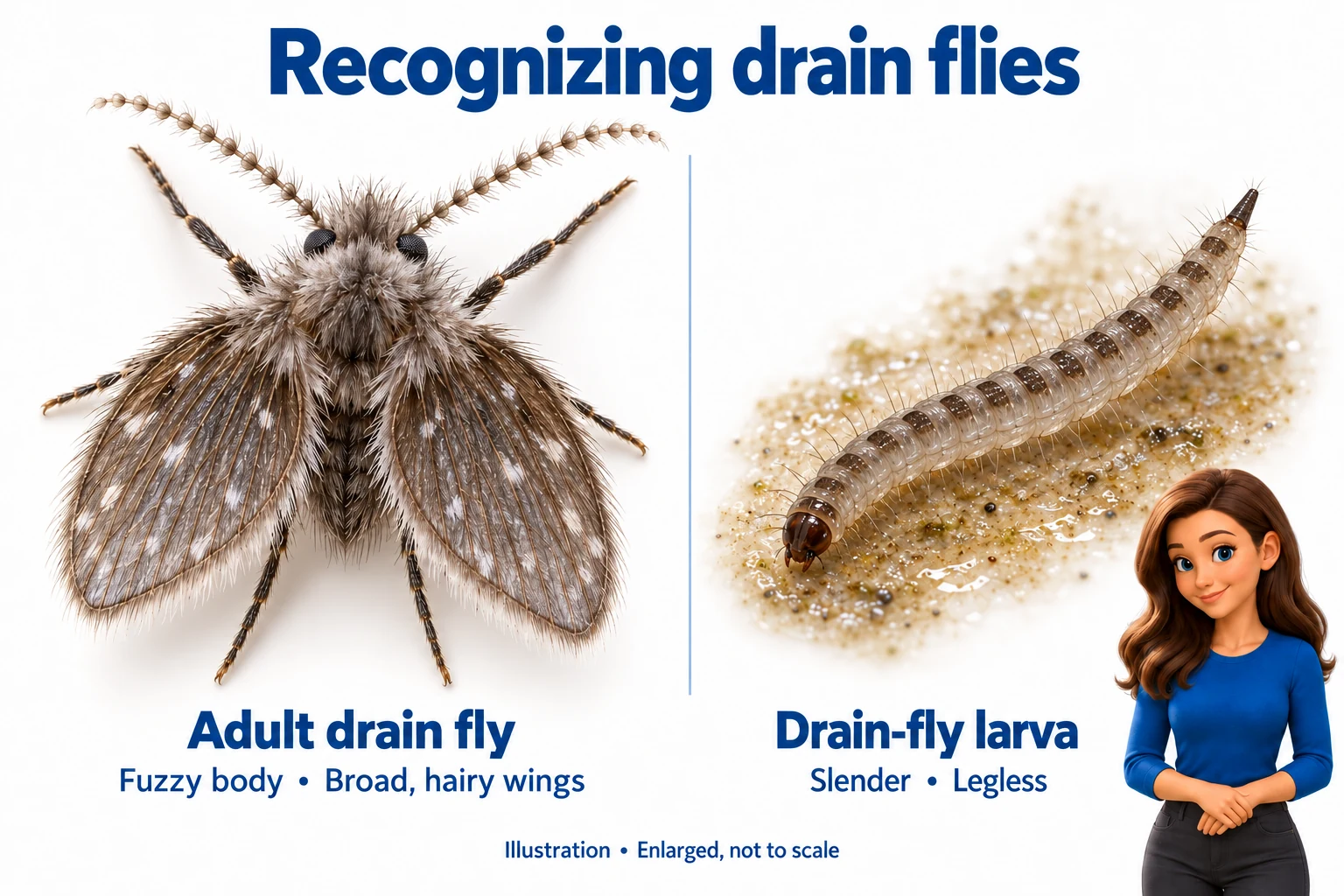
- The adult has a fuzzy, moth-like appearance rather than a smooth, ordinary fly shape.
- Adults may rest on walls, counters or surfaces near the source.
- The larvae look different from the adults and can be found in wet organic film.
- The room where adults gather is a clue, not proof of the breeding location.
🛑 University of Arkansas Extension's drain-fly guide describes their appearance and association with household drains and other wet sites. Use a clear photograph or an identification service if the insect does not fit; do not select a pesticide from a guess.
How do you find the source of drain flies?
Inspect owner-accessible areas before deciding that a sewer pipe is damaged:
- Residue beneath removable drain covers and around stoppers.
- Accessible sink-overflow openings.
- Little-used shower or floor drains that can be checked safely.
- Wet waste, dirty buckets and damp cleaning equipment.
- Leaks or persistently wet materials around fixtures.
Check more than one place. A fly beside the sink doesn't prove the sink is the only source. Larvae alone don't mean you need excavation or septic work.
Keep a simple source-check log. For each location, record the date, what you saw, the safe action you took and what changed when you checked again. This helps you focus on the sites with evidence.
| Site and date | Observed evidence | Safe action taken | Recheck result |
|---|---|---|---|
| Drain cover or stopper: ________ | Adults, larvae, film or no visible evidence: ________ | Accessible cleaning or no action: ________ | Activity and wetness: ________ |
| Overflow or little-used drain: ________ | What was visible without dismantling: ________ | Action allowed by fixture instructions: ________ | Activity and wetness: ________ |
| Wet waste, tools or leak area: ________ | Location of wet material: ________ | Cleaning, drying or repair arranged: ________ | Activity and wetness: ________ |
🛑 A site with no visible evidence is not proof that a hidden source is absent. Do not remove fixed plumbing, inspect a chemically treated drain or open a sewer cleanout to fill in the log. Persistent activity or plumbing symptoms need the qualified help described below.
Remove the source safely
- Confirm the likely insect. Keep a photo and note where adults and larvae appear.
- Remove reachable material. Clean washable waste containers and appropriate removable drain parts using their instructions.
- 🛑 Clean accessible film. Use a suitable brush and an approved method; do not force tools into concealed plumbing or work in a chemically treated drain.
- Correct ongoing wetness. Arrange repair of a leak or drainage fault instead of continually treating the insects.
- Recheck the identified sites. Record whether activity declines and whether an overlooked source remains.
Minnesota Extension emphasizes removing the organic breeding material. It notes that hot or boiling water, bleach and chemical drain cleaners are not effective control for moth flies. A biological cleaner may be suitable when its label and the fixture's instructions allow it.
🛑 Do not apply an insecticide inside a drain unless its label specifically permits that site and use. Keep cleaners separate and follow product precautions.
When cleaning does not resolve it
If activity continues, the source may be hidden, the insect may be misidentified or an area may still be wet. A pest professional can identify the insect and check breeding sites. A plumber can investigate leaks, backups and drainage defects.
- Get plumbing help for multiple slow drains, wastewater backup or visible leakage.
- Get identification help if the organism does not match the expected adult or larval appearance.
- 🛑 Do not open a sewer cleanout, enter a septic tank or cut into walls to look for larvae.
Reduce future breeding sites
- Remove debris collected by drain covers and strainers.
- Clean accessible film rather than relying only on deodorizer.
- Dry washable tools and deal with wet waste promptly.
- Repair leaks and check little-used bathrooms periodically.
Conclusion
For drain flies, follow four steps: identify, locate, clean and recheck. Use the fixture-specific guides above to choose your next check. Get qualified help if you can't safely reach the source or plumbing symptoms persist.
Browse our Plumbing guides for more practical bathroom and drain troubleshooting.

Scott Harding
Scott is the main author of DIY Home Comfort. He's also an experienced HVAC technician who enjoys home renovation and spending time with his family. You can find out more about him here.