Home Battery vs Generator vs Portable Power Station
Compare home batteries, fuel generators and portable power stations by supported loads, outage duration, replenishment, safety and ownership costs.
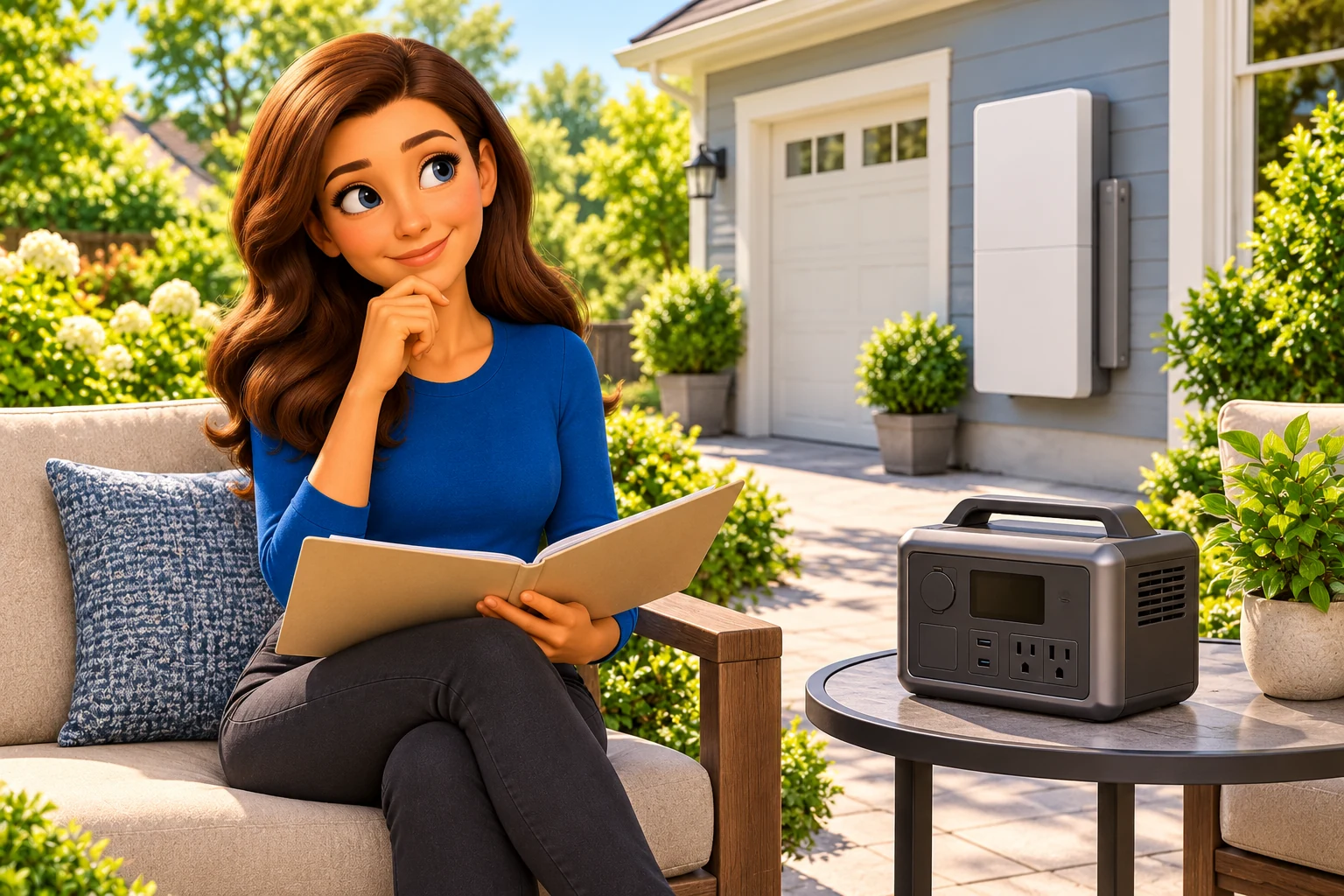
A home battery vs generator decision starts with the outage you want to cover. A stationary battery can supply supported loads until its finite stored energy runs down. A fuel generator can keep running while fuel, safe conditions and service remain available. Either choice has limits on appliances and outage duration.
A portable power station is another battery option, usually for a smaller set of compatible plug-in loads. Compare all three by output, energy, replenishment and safe operation. The home battery storage guide covers the wider stationary-storage buying process.
Compare stationary batteries, generators and power stations
| Option | What supplies energy? | Planning advantage | Constraint to resolve |
|---|---|---|---|
| Stationary home battery | Stored electricity, with charging from approved grid or solar sources | Can provide automatic backup and everyday energy management in a suitable design | Finite energy, supported loads, transfer behavior and outage recharging |
| Fuel generator | Fuel converted into electricity | Can continue beyond one stored battery charge when fuel and operation remain available | Carbon monoxide, location, refueling or fuel supply, maintenance and approved connections |
| Portable power station | Stored electricity with model-specific charging options | Can serve selected compatible plug-in devices without a whole-house installation | Limited energy/output, charging time and suitability for the actual devices |
A standby generator and a portable fuel generator are also different projects. A permanently installed unit has its own fuel, siting, transfer and service requirements. Do not use portable-generator instructions as a complete installation guide for a standby unit.
Define the loads and outage duration first
List the services you need: refrigeration, lighting, communications, a well or sump pump, and temperature protection. Decide what must work at once and what can wait. Then check whether each source can start the equipment, keep it running and provide enough energy for your target time.
For batteries, the home battery sizing worksheet separates usable kWh from continuous and starting output. For generators, compare the applicable continuous output and motor-start capability with the same load schedule; a large starting-watt headline is not necessarily the sustained rating.
If air conditioning is a priority, read whether a battery can run an air conditioner. Refrigeration, pumps and HVAC can introduce starting demands that a simple daily-energy total misses.
🛑 For powered medical equipment or another load that must not lose supply, arrange an equipment-specific continuity plan with the relevant provider. A home backup system is not automatically an uninterrupted supply.
Evaluate replenishment during a long outage
A grid-charged battery can't depend on the grid during an outage. Solar can extend operation only if the installed solar, battery and controls support islanded charging and have enough sunlight. Islanded means operating separately from the grid. Allow for winter weather, shade and household use at the same time.
Ask what happens after a low-battery shutdown and how the approved system restarts. The solar outage guide explains why ordinary grid-connected solar is not automatically an outage charging source.
Plan how you'll replenish generator fuel too. Portable supplies run out, and an outage may disrupt resupply. Follow the manual for weather, cooldown, refueling and maintenance. A piped-fuel standby generator depends on its fuel supply and approved installation. Ask how either option would handle several days with limited service access.
For a vehicle-based alternative, use the separate V2X preparation guide. A large vehicle battery alone does not establish home-backup compatibility or availability of the required equipment.
Plan generator safety before buying
Fuel generators create carbon monoxide. Check this hazard separately from electrical sizing. A property without a safe operating location may be unsuitable for the generator plan.
🛑 Operate a portable fuel generator outdoors only, at least 20 feet from the home, with its exhaust directed away from the home and other occupied buildings. Never run it in a house, garage, basement or other enclosed space, even with doors or windows open.
The U.S. Consumer Product Safety Commission's carbon monoxide guidance also calls for working CO alarms on every level and outside sleeping areas. Check the generator's instructions and whether the property can actually provide a safe operating location; an open garage is not that location.
🛑 If a CO alarm sounds or carbon monoxide poisoning is suspected, get everyone outside to fresh air immediately and call 911 from a safe place. Do not stay inside to investigate the equipment.
A battery has no combustion exhaust during normal discharge. It still has electrical, thermal and product-specific safety requirements. Check a portable power station's manual for charging, placement, ventilation and connected devices. Don't assume every indoor location is suitable.
Check connections and transfer behavior
For household circuits, have a qualified installer specify the approved transfer and isolation equipment. Ask which circuits will be available, what brief interruption may occur and how loads are controlled. The whole-home vs critical-loads guide helps distinguish coverage from the promise that every load can run at once.
🛑 Never backfeed household wiring through an ordinary wall receptacle or use an improvised connection. Keep utility isolation and circuit connection design with qualified personnel.
Plug-in operation is a different scope: confirm the device's voltage, output, connection and operating instructions. Do not assume an adapter makes a portable source suitable for a fixed appliance or a household circuit.
Some supported designs combine a battery with a generator. Ask for written approval of the exact equipment combination, charging path, controls and operating limits. Compatibility needs confirmation before you plan to use them together.
🛑 Connecting incompatible power sources can create electrical hazards or damage equipment. Do not connect one source to another based only on matching plugs; use the approved design and qualified installation.
Compare total ownership and everyday usefulness
Compare complete installations and ongoing costs. Include electrical work, transfer equipment, fuel installation or storage, maintenance, service access and any subscriptions or program conditions. A hardware price alone leaves out much of the comparison.
Ask about operating sound at the proposed location, including a battery's cooling fans and the generator's engine, and request relevant product data. A battery is not necessarily silent. Sound preferences do not override required placement, ventilation, exhaust separation or access.
A battery may also shift energy between tariff periods or retain solar for later use. That value depends on the actual tariff, losses, reserve and dispatch rules; the hub's bill-value example shows why avoided imports are not the same as profit. A generator's main purpose is usually outage supply, so assess its value against the outage service you need.
Compare warranty terms and service support, too. The battery warranty guide separates capacity retention, usage limits and remedies. The installation checklist helps reveal scope that a hardware-only offer can omit.
Ask each provider the same four questions in writing. Which loads can it support? For how long? How will it be replenished? Under which conditions? Use those answers to compare the outage service you need.
Conclusion
Choose around your loads, target duration and a safe replenishment plan. A stationary battery can offer automatic backup and daily energy management. A generator can extend runtime while fuel and safe operation remain available. A portable power station may fit a smaller plug-in task. Confirm the actual equipment and installation before buying.
Continue reading our Energy Efficiency guides.

Scott Harding
Scott is the main author of DIY Home Comfort. Learn more about the team and our approach on the About page.