Local vs Cloud Home Energy Management: Privacy and Offline Control
Compare local, cloud and hybrid home energy controls. Check internet-outage behavior, privacy, data access, product support and device interoperability.
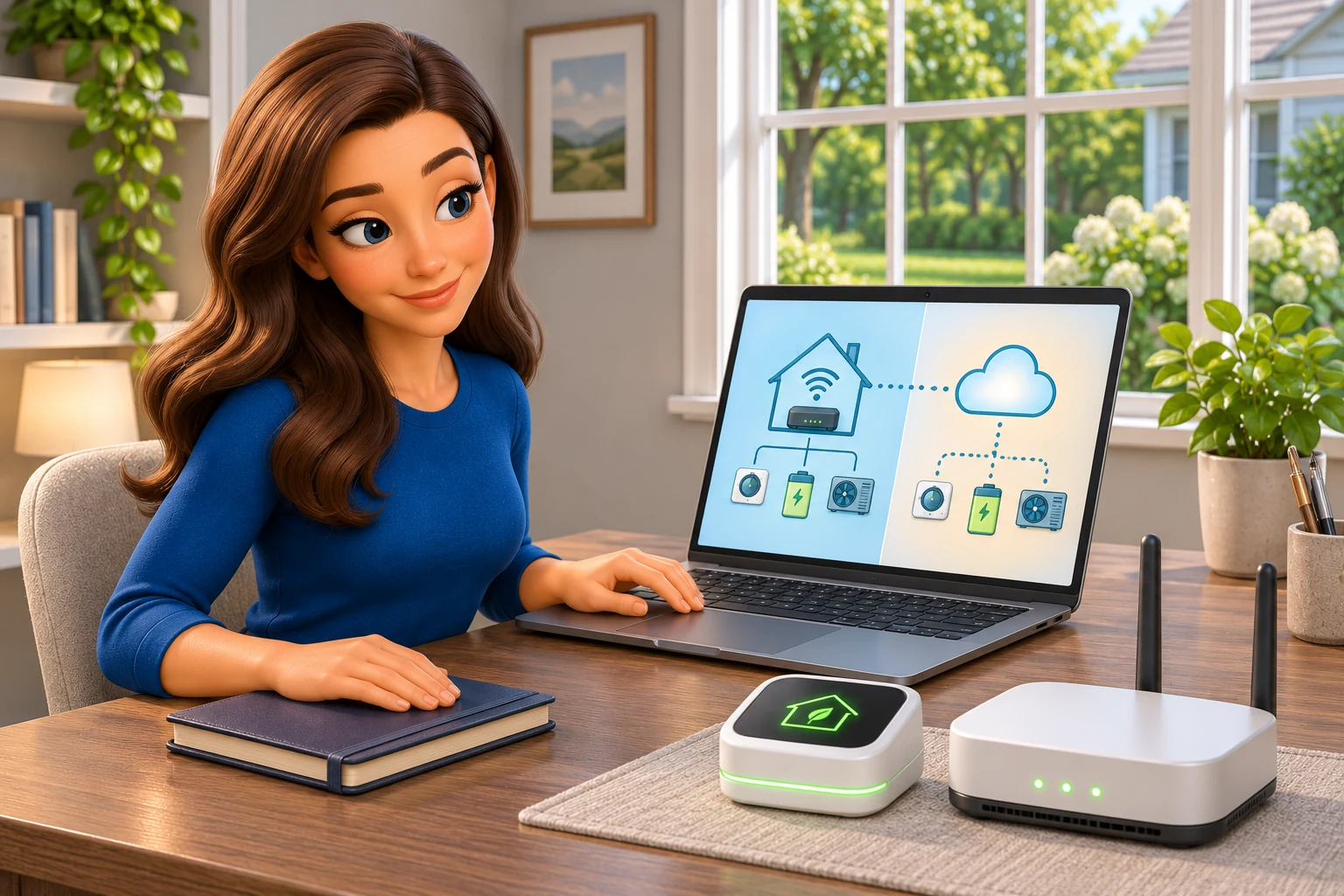
A local home energy controller makes some decisions inside the home network. A cloud-based system depends on a remote service for some information, analysis or commands. Many products combine both approaches. The useful question is which functions still work when a connection, account or vendor service is unavailable.
“Local” does not automatically mean private or reliable, and “cloud” does not automatically mean unsafe. Check the data flow, control path, fallback behavior and ongoing support for the exact products you plan to connect.
Compare where data and commands travel
Draw a simple path for each important function: the meter or device, the home controller, the router, the internet service and the vendor cloud. Mark where the measurement is stored and where the command is decided. A device can report locally while relying on a cloud account for remote access or automation.
Ask whether the system supports direct local control, uses a vendor cloud-to-cloud link, or passes through a bridge. Confirm which features require a subscription or ongoing account.
Matter's device model includes specific energy-related capabilities such as reporting electrical usage or planned consumption, but certification for a connection standard does not prove that every product supports every function your project needs. Review the Matter device-type descriptions and the product's own compatibility list.
Test what works without the internet
Before depending on automation, ask the manufacturer or installer what happens if the internet is down, the router restarts or the vendor service ends. Check each function you care about: thermostat control, battery reserve, EV charging, schedule changes, alerts and local manual operation.
ENERGY STAR's connected thermostat criteria provide a limited example: certified models must work as a basic thermostat without their service-provider connection. That does not establish offline behavior for the rest of a HEMS. Ask for the specific thermostat criteria and test your complete device chain.
Keep essential device safeguards at the device or manufacturer's control layer. A whole-home controller should not be the only way to operate heating, cooling, charging or battery reserve.
Review privacy, account and security practices
Energy data can reveal when equipment runs and when a home may be occupied. Check whether the provider collects interval data, device names, location, occupancy signals or remote-control history. Look for the retention period, third-party sharing, account deletion process and how access is revoked if you stop using the service.
NIST's consumer IoT guidance treats cybersecurity capabilities as product-wide considerations, which can include the device, app and supporting services. Use NIST IR 8425 as a checklist for asking about updates, authentication and product support, not as a certification of a particular energy system.
Use a unique password, enable multi-factor authentication where offered, keep device software updated and remove accounts you no longer use. Review the separate thermostat privacy and support considerations when a climate control account is part of the system.
Ask these questions before buying
- Which measurements and commands are local, and which require cloud access?
- Does the schedule continue during an internet outage or only while a vendor service is available?
- Can I export my history and revoke access without deleting device-level safety settings?
- How long does the manufacturer promise software or security updates?
- What happens if the company changes its app, subscription or server support?
Make a short list of must-work functions and test them after installation. Record how to switch the controller to manual or factory-supported operation.
Conclusion
Local and cloud controls solve different parts of a home energy system. Choose based on the exact data flow, offline behavior, privacy terms and support plan, then verify the functions you depend on.
Explore our Energy Efficiency guides for more on connected controls, heat pumps, solar and storage.

Scott Harding
Scott is the main author of DIY Home Comfort. Learn more about the team and our approach on the About page.