Magnetocaloric and Electrocaloric Cooling: Promise and Practical Limits
Learn how caloric cooling materials work, why prototype results differ from whole-system performance, and what evidence is needed before household adoption.
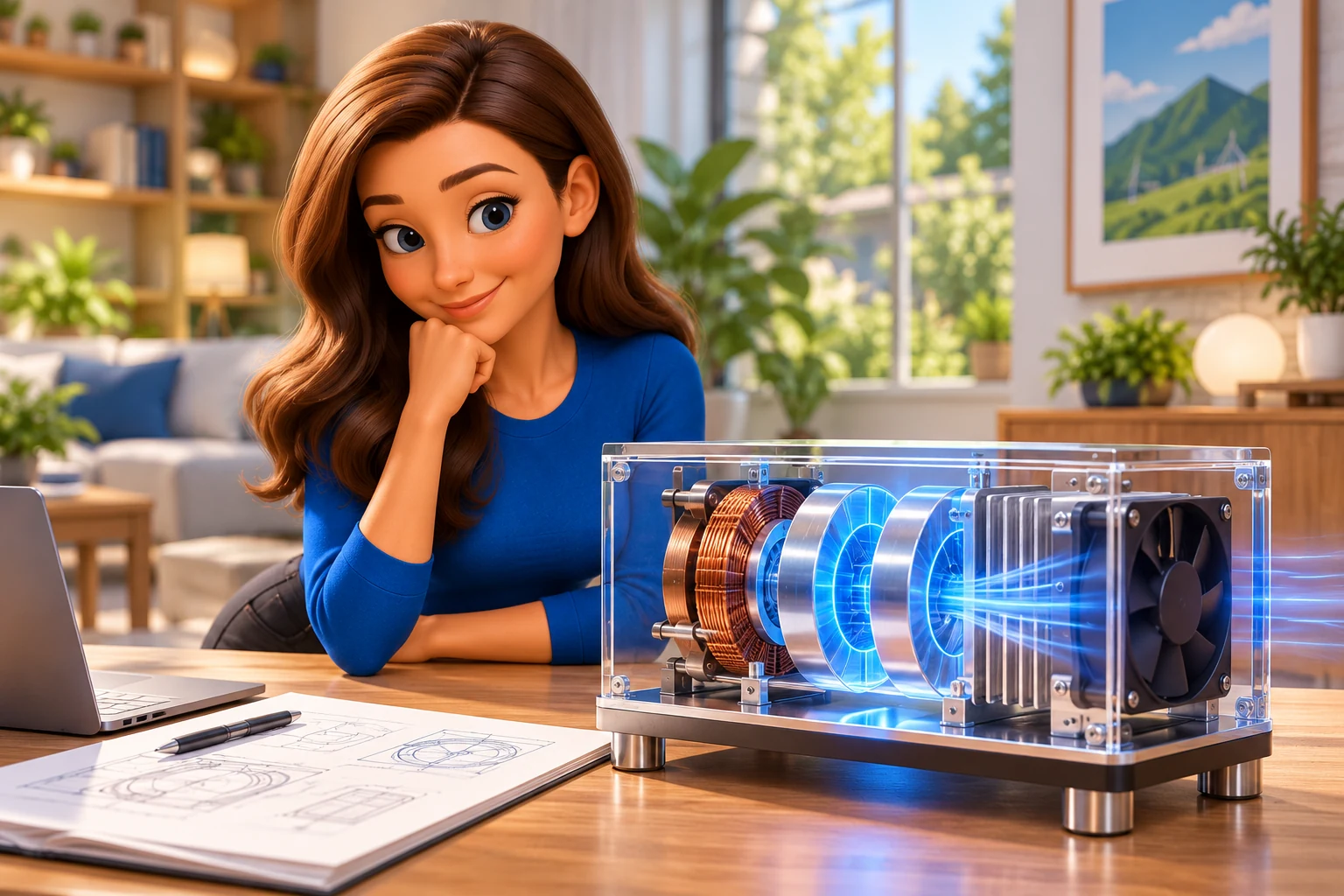
Magnetocaloric and electrocaloric cooling use materials that change how they absorb or release heat when a magnetic or electric field is applied or removed. Researchers build cycles around these effects to absorb heat in one place and release it in another. The approaches are promising, but demonstrating the material effect does not demonstrate a complete home air conditioner.
Magnetocaloric cooling
Magnetocaloric materials respond to changes in magnetic field. A practical cycle coordinates field changes and heat transfer so useful cooling can occur repeatedly. The complete design may require magnets, movement, a regenerator, heat exchangers and a heat-transfer fluid or other thermal-transfer mechanism.
The DOE magnetocaloric project description is a 2015 project description for a proposed 500 W solid-state demonstration. It contrasts that approach with existing fluid-and-pump prototypes. It should not be relabeled a 2022 demonstration of a market-ready household system.
Electrocaloric cooling
Electrocaloric materials respond to changes in electric field. Useful equipment must manage electrical input, thermal contact, heat rejection and repeated cycling. Material temperature change alone does not establish delivered cooling at a useful temperature lift.
A 2024 electrocaloric prototype paper uses ethanol as a heat-transfer fluid. That example shows why solid-state active material does not necessarily mean the complete machine contains no fluid, pump or moving component.
How to judge a prototype claim
| Reported quantity | Question to ask |
|---|---|
| Material temperature change | Under what field, starting temperature and test conditions? |
| Cooling power | What useful load was removed, and for how long? |
| Temperature lift | What difference was maintained between cold and hot sides? |
| COP | Which electrical and mechanical inputs were included? |
| Durability | How many cycles and under what operating conditions? |
| Scale and cost | Is this a material sample, laboratory device or manufactured complete system? |
A favorable value for one measure does not establish all the others. Noise, serviceability, production cost, safety and long-term reliability also require evidence. Do not infer a fixed 30–50% home saving, silence or a longer life from the mechanism alone.
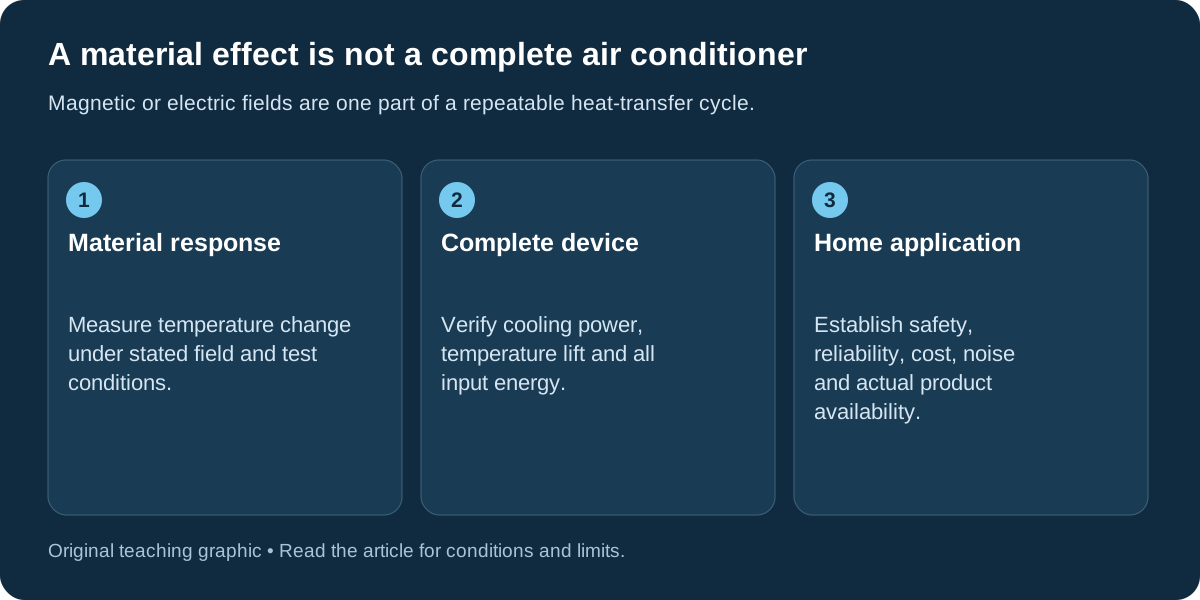
Environmental claims need a complete boundary
Avoiding a conventional refrigerant can be useful, but it does not establish zero emissions. Electricity generation, materials, manufacturing, any working fluids and end-of-life handling remain part of the assessment. Magnetic or electric fields also require suitable engineering and controls.
A concept illustration should be labeled as such and should not be presented as a photograph of a verified product or installation.
What homeowners can do now
Do not delay essential cooling or safety work based on an unsupported commercialization date. Compare currently available equipment with the home's load, climate, humidity needs, complete installed cost and service support. Heat-pump and AC cooling provides a practical comparison.
Follow research by looking for complete-system tests under stated conditions and independently inspectable results. A commercial-building demonstration or a small cooling load is not automatically evidence for a whole house.
Conclusion
Caloric cooling is a research field with real physical mechanisms and important engineering challenges. Judge demonstrated system performance separately from material claims, and use our HVAC efficiency guide for improvements available today.
Continue with our heat-pump guides for related homeowner decisions.

Scott Harding
Scott is the main author of DIY Home Comfort. Learn more about the team and our approach on the About page.