Microinverter vs String Inverter: Compare Roof Fit, Cost and Service
Compare string inverters, microinverters and optimizers by roof layout, shading, monitoring, service and exact storage or backup compatibility.
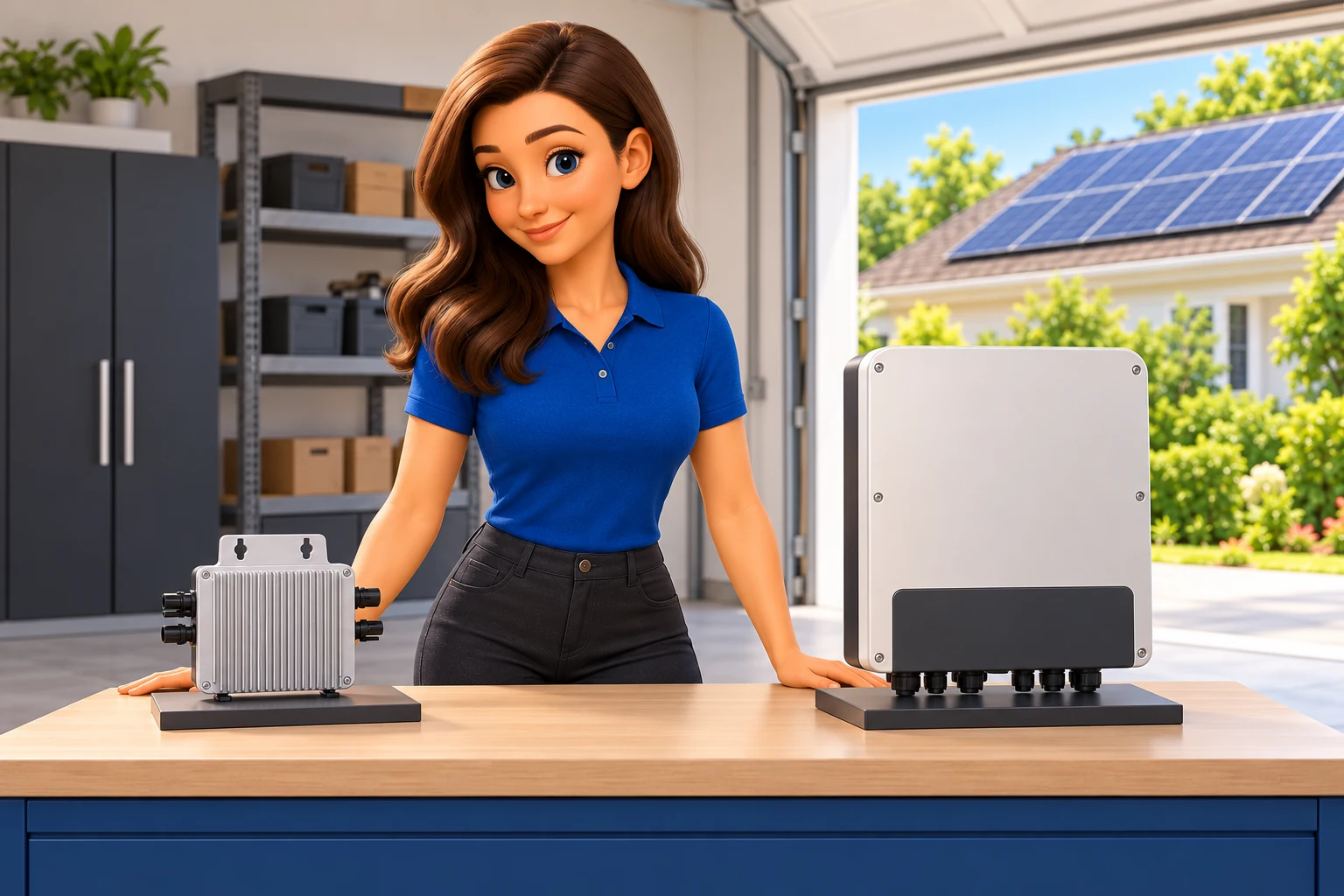
The microinverter vs string inverter choice affects how panels connect, where solar electricity is converted for home use, and how you'll monitor and service the system. Both can work well in a suitable design. Compare complete proposals for your actual roof.
For a simple unshaded roof, a string design may be practical. Several orientations or uneven shade may make module-level equipment worth comparing. This guide also covers optimizers, which are a different approach from microinverters. Return to the home solar guide for the full planning sequence.
Understand the three common designs
Solar panels make direct current (DC). Your home and the grid generally use alternating current (AC). The inverter converts DC to AC. Where it sits affects the system architecture, but doesn't by itself prove production, safety compliance or backup capability.
| Design | Where DC becomes AC | What to compare |
|---|---|---|
| String inverter | At a shared inverter connected to one or more panel strings | String grouping, independent tracking inputs, shade response and accessible service |
| Microinverters | At module-level units, commonly one per panel | Exact panel compatibility, unit output limits, roof access and system controls |
| Optimizers with a compatible inverter | At the shared inverter; optimizers condition DC at the modules | Required inverter/optimizer pairing, monitoring, service and replacement compatibility |
The Department of Energy's inverter overview explains the conversion and common string and microinverter arrangements. Product details still depend on the exact equipment combination.
Compare shade and roof faces without exaggerating the gain
Module-level equipment works at individual panels. It can reduce some electrical mismatch losses when panels get different sunlight. It can't replace sunlight blocked by a tree. Ask for the shade survey and comparable annual production estimates for each layout.
Shade on one panel doesn't always shut down every panel on a string. Bypass diodes, string layout, inverter tracking and the shade pattern affect the result. A microinverter design won't always give a large production gain over a well-designed string system either.
Multiple roof directions also need a considered design. Some string inverters have multiple maximum power point tracking (MPPT) inputs that can serve separate groups. The allowed grouping and electrical limits are model-specific. The roof suitability guide explains the site information that should come first.
Keep AC and DC ratings clear
The array's DC nameplate capacity and the inverter's AC output limit measure different things. A designer may intentionally choose more DC array capacity than AC inverter capacity. In strong conditions, AC output may flatten at the inverter limit. That's called clipping.
Some clipping can be part of a deliberate design trade-off. Its presence does not prove a fault, and its absence does not prove the system is well sized. Tesla's system-performance guidance describes the relationship between array and inverter ratings. Ask how much annual energy the model expects to lose to clipping and what an alternative design would cost.
Require the full equipment schedule: panel count and model, inverter model and quantity, DC array kW, AC output kW, and any export limit. A price per watt comparison should identify which capacity basis it uses. Our solar quote checklist keeps these quantities separate.
Compare monitoring and the practical service plan
Module-level equipment may offer detailed monitoring. Check which homeowner view, communications hardware and ongoing access the quote includes. A string inverter can also provide useful production and fault data. Ask to see the platform you'll actually get.
- Who watches for an alert, and who contacts the homeowner?
- Is internet access needed for remote reporting, and what happens to stored data during an interruption?
- What parts, labor, travel and roof access are covered under each warranty?
- Who services the system if the original installer goes out of business?
- How will replacement compatibility be handled if a model is discontinued?
A shared inverter fault may affect its connected array. If one microinverter fails, others may keep working. Shared breakers, communications, wiring or controls can still affect several units or the whole system. Ask about these common points of failure for either design.
Roof-mounted electronics can require roof access for replacement. A ground-accessible inverter can simplify some service visits. Neither point tells you how often equipment will fail or what it will cost over its life: ask for the actual labor terms and planned equipment access.
Check storage and backup compatibility by model
Ask what “battery ready” means in writing. Which batteries and controllers work with it? What extra hardware would you need? Would adding storage affect the warranty or utility approval?
AC-coupled storage connects through AC conversion; DC-coupled designs share a DC-side relationship with the solar system. The choice can affect conversion paths and retrofit options, but generic labels do not settle compatibility, permitted operation or backup behavior.
Ordinary grid-connected solar does not power the home through an outage just because it uses microinverters, optimizers or a hybrid-labeled inverter. A functioning backup design needs the appropriate equipment and configuration. Use the solar outage guide to request load, isolation and restart evidence.
The AC coupled vs DC coupled battery comparison explains the separate retrofit, conversion and outage-charging questions.
Compare complete options for the same goal
Compare the same roof layout, production assumptions and warranty scope. If a bidder adds module-level equipment, ask for its modeled benefit and full extra price. Resolve differences in panel count or tariff assumptions before crediting the inverter with a savings difference.
🛑 Use the solar sizing worksheet to establish the energy target first. Electrical design, rapid-shutdown compliance and installation belong with qualified personnel and the applicable local approval process. Do not open an inverter enclosure to identify its components.
Conclusion
Choose an inverter arrangement that fits your roof, documented production estimate, service plan and future equipment needs. Confirm exact model compatibility and the complete installed scope before you decide.
Continue with more Energy Efficiency articles.

Scott Harding
Scott is the main author of DIY Home Comfort. Learn more about the team and our approach on the About page.