Solar-Powered Air Conditioning: Retrofit Options, Costs and Sizing
Plan a solar-powered air conditioning retrofit for 2027. Compare system options, sizing, installed-cost assumptions, incentives and backup requirements.
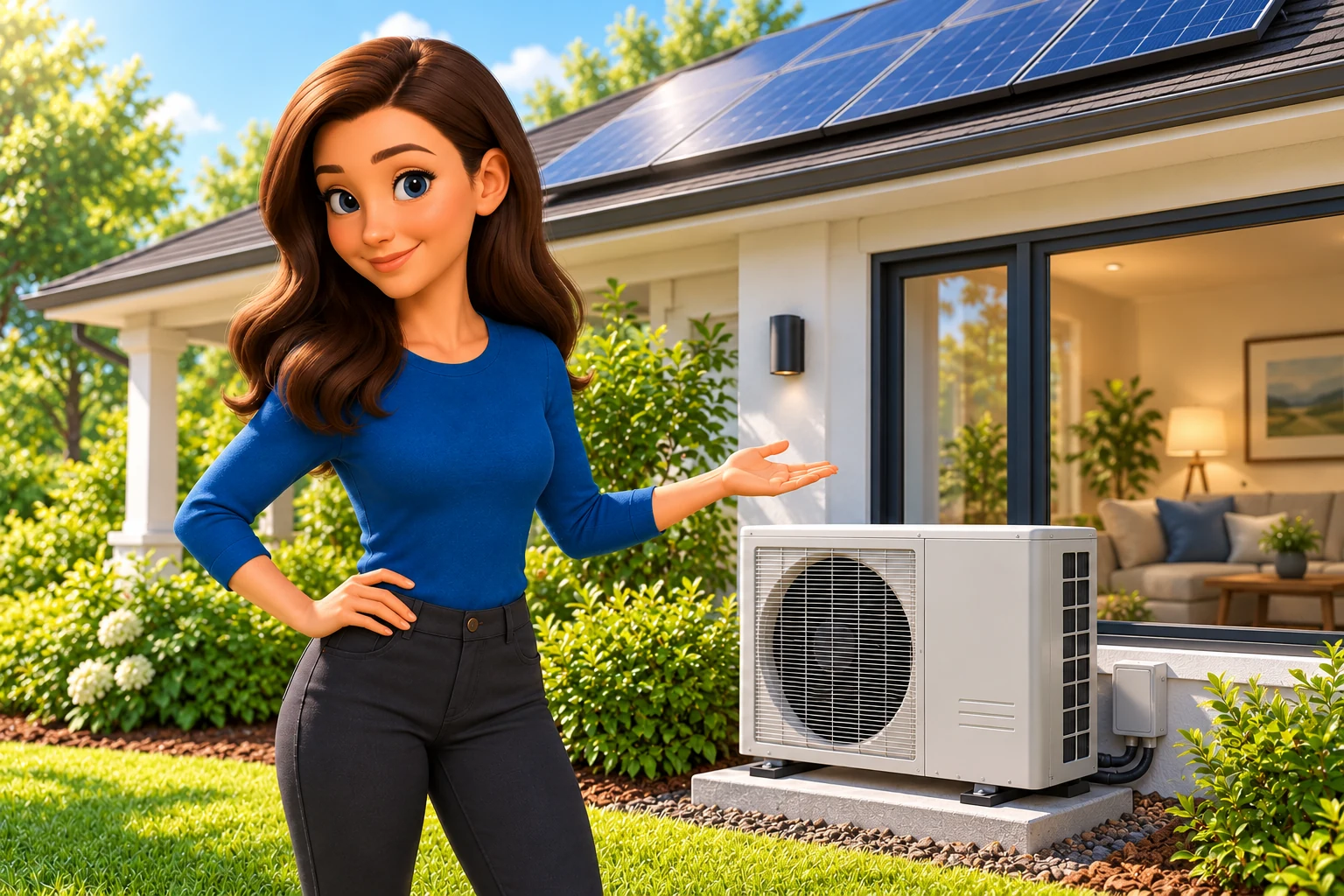
Solar-powered air conditioning can use solar electricity to offset some cooling demand. Whether a retrofit makes sense depends on your cooling load, the equipment, when the panels produce electricity, your utility tariff and the complete installed cost. Start with a design and a written quote rather than a promised savings percentage.
Key Takeaways
- PV panels produce electricity; cooling capacity and electrical input are different quantities.
- Grid-connected solar, purpose-built solar-compatible AC and backup-power systems have different requirements.
- Size the AC from a cooling-load calculation and the array from an energy-production model.
- Budget for the full installation before assuming any incentive or payback.
Solar-powered air conditioning retrofit options
| Option | What it does | What to verify |
|---|---|---|
| Conventional AC with grid-connected PV | The solar system supplies electricity to the home; the utility supplies the remaining demand. | Solar production, AC consumption, interconnection and export compensation. |
| Purpose-built solar-compatible AC | Uses the manufacturer's specified solar input and, where supported, grid assistance. | Exact panel-input limits, compatible components and operation during low sunlight. |
| Solar plus backup storage | Can support selected loads during an outage when designed for backup operation. | Inverter output, usable storage, starting demand and safe grid isolation. |
An ordinary mini-split cannot simply be connected to a PV string. A manufacturer's term such as “hybrid” does not by itself establish battery compatibility or outage capability. Ask for the exact operating modes in writing.
Sizing your system
One ton of cooling capacity equals 12,000 Btu/h of heat removal. It does not mean the AC draws 12,000 watts, and floor area alone does not determine the correct tonnage. Have a qualified contractor assess the building's cooling load and select equipment for the design conditions.
For the solar design, compare estimated hourly generation with the AC's electrical demand. Roof orientation, shade, location, weather and losses affect output. The Department of Energy's solar guide describes site assessment and production-estimation resources. A fixed “1 kW of PV per ton” rule cannot establish the right array for every home.
Illustrative energy example: an AC averaging 1 kW for six hours uses 6 kWh. An array producing 6 kWh over the day may generate some of it when that AC is off. Matching daily totals alone does not prove solar-only operation or eliminate grid imports.
For the wider household load, use our solar panel sizing worksheet rather than sizing the roof around cooling alone.
Budgeting for a retrofit
Request an itemized installed price covering the AC, panels, compatible power electronics, mounting, structural work, electrical work, permits, utility requirements, commissioning and any battery. Separate optional backup equipment from the cooling-and-solar scope.
Use the same scope when comparing proposals; a parts subtotal does not capture installation cost. Obtain current quotes rather than treating a sample parts list as a national price benchmark. The FTC's solar consumer guidance offers questions about bids, contracts and warranties.
Incentives and payback
For a new project, do not deduct the former federal Residential Clean Energy Credit. The IRS Form 5695 instructions end that credit for expenditures after December 31, 2025. Previously eligible credit carryforwards are a separate matter. Check current utility and state program terms individually; eligibility for one component does not establish eligibility for the whole project.
Hypothetical simple payback: $8,000 of incremental installed solar-related cost divided by $400 in annual net bill savings equals 20 years. These are assumed inputs, not a price or savings forecast. Compare with the cost of the replacement AC you would otherwise buy. Financing, maintenance, replacement costs, changing tariffs and the time value of money can change the result.
Installation and safety
🛑 Use qualified solar, electrical and HVAC professionals for regulated work. Roof attachments, PV string voltage, conductor selection, protective devices, refrigerant piping and commissioning must follow the exact equipment instructions and locally adopted requirements. Obtain permits and utility permission where required.
🛑 There is no universal string voltage, roof-load allowance, mounting height, pressure-test value or evacuation procedure for this article to prescribe. Ask the contractor to document the applicable rapid-shutdown and electrical-protection requirements. Never add a string to an existing combiner without a reviewed design.
Will it cool during a power outage?
Do not assume rooftop solar keeps the AC running when the utility fails. Backup operation needs equipment and controls designed for that purpose. The DOE inverter guide explains that appropriately designed solar-and-storage systems can operate without grid support.
Battery runtime depends on usable energy and actual load. As a simplified example, 2 kWh of usable energy divided by a constant 1 kW load gives two hours before additional losses or reserve requirements. Have the designer account for those factors in a backup-runtime estimate.
Questions before you sign
- What cooling-load calculation and equipment models support this design?
- What hourly solar output and utility tariff were used to estimate savings?
- Which loads can run in an outage, and for how long under the stated assumptions?
- Who handles permits, inspections, commissioning and service?
- What do the written equipment and workmanship warranties cover?
Frequently asked questions
Can solar cover all of my cooling?
It may cover part or all of the cooling electricity over a chosen period, but simultaneous operation depends on available output and demand. Ask for separate annual-offset and outage-performance estimates.
How many panels do I need?
Use the planned cooling consumption, the site's production model and the chosen equipment's limits. Panel count alone is not a sizing method.
Will a retrofit preserve my warranty?
Verify the written terms for the exact equipment and installation. Code compliance alone is not a guarantee of warranty coverage.
Conclusion
Solar-powered air conditioning is a design and budgeting decision. Compare equipment compatibility, hourly production, complete installed cost and realistic bill savings before proceeding. For the HVAC side, start with our heat pump buying guide and installation quote checklist.
Explore more energy-efficiency guides to plan the next step for your home.

Scott Harding
Scott is the main author of DIY Home Comfort. He's also an experienced HVAC technician that enjoys home renovation and spending time with his family. You can find out more about him here.