Charging Two Electric Cars at Home: Make a Plan That Works
Plan home charging for two electric cars. Compare shared charging, power controls and departure times so each car gets the energy it needs.
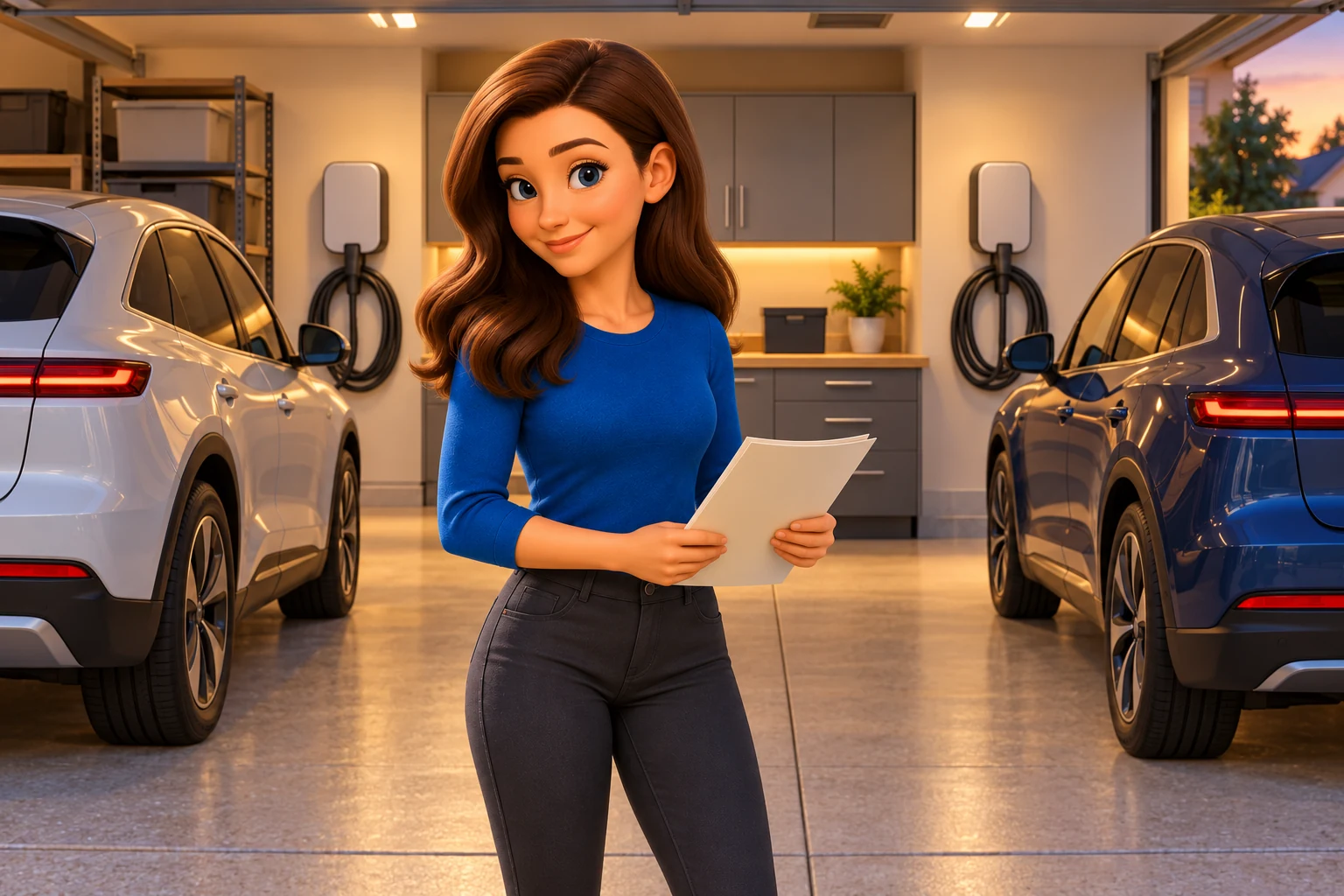
Charging two electric cars at home means getting each car ready before its driver needs to leave. You may be able to share a charging spot or use approved power-sharing equipment. You don't always need two chargers running at full power.
The setup must stay within safe electrical limits even when your routine changes. You'll compare energy in kilowatt-hours (kWh) and charging rate in kilowatts (kW). Start with the home EV charging guide, then use the worksheet below to plan for both cars.
Make a plan for each car
Write down each car's usual miles, longest regular drive, time plugged in and next departure. Check the charging-port locations and parking spaces too. A charger won't be convenient if one car blocks the other or the cable can't reach safely.
| Input | Car A: invented example | Car B: invented example |
|---|---|---|
| Daily miles charged for at home | 45 | 30 |
| Energy used from the battery | 0.30 kWh/mile | 0.30 kWh/mile |
| Assumed charging efficiency | 90% | 90% |
| Energy needed from the wall | 15 kWh | 10 kWh |
| Planning deadline | First driver to leave in the morning | Later departure, if the car is still home |
Together, these example cars need 25 kWh from the wall. Use your own figures when you plan. If your energy-use figure already includes charging losses, don't add them again. The charging cost worksheet explains how to check.
Compare three ways to charge
| Arrangement | Useful when | Question to resolve |
|---|---|---|
| Use one charging spot in turn | Both cars can finish on time and someone can reliably switch the connection | Who switches cars, when, and what happens if they forget? |
| Use approved equipment that shares power | Both cars can stay plugged in while the system divides the available power | Do the exact devices and the controls you need work together? |
| Use separate, professionally checked supplies | Your home and schedules justify more power for charging at the same time | Does the electrician's full check support the design, and is the extra cost worthwhile? |
One car might manage with a suitable lower-rate connection. Use the Level 1 vs Level 2 comparison for each vehicle. Their needs may be different.
🛑 Electrical safety: Never use an ordinary splitter, extension cord or makeshift adapter to charge two EVs. Any sharing device must be approved for that use. Have a qualified professional check the circuit, and follow the device's safety listing, instructions and local rules.
Check whether both cars can finish in time
Suppose an electrician-approved design provides a steady 7.2 kW in total for charging. Supplying 25 wall kWh would take about 3.47 hours. Eight hours could provide 57.6 kWh if charging stayed at that rate without pauses. But three cheap-rate hours would provide only 21.6 kWh, which is short of the target.
This checks whether enough energy could be delivered. It isn't an installation design. Power controls, vehicle limits, battery heating or cooling, pauses and time away can reduce charging. The amount available may not stay at 7.2 kW all night.
Check each car's deadline as well as the total. If Car A is plugged in for only two hours before leaving, the full example rate of 7.2 kW supplies 14.4 kWh. That's less than its 15-kWh need. You might finish both cars later in the night and still leave the first driver short.
Allow some spare time and try the plan against a busy day. Don't base it on perfect charging with no missed connections.
Check what power sharing actually controls
Sharing power between cars and managing the whole home's demand are different jobs. One system divides a charging limit between vehicles. The other responds when household appliances need power. Check whether your equipment can do both together.
For example, Tesla's Wall Connector guidance describes Group Power Management for compatible Gen 3 units. It says Dynamic Power Management is for a single unit and can't work across multiple Wall Connectors. Ask the installer to confirm the exact setup. Two feature names on a product page don't prove they can work together.
Ask what happens when one car finishes early, accepts a lower AC rate or loses communication with the system. Also ask how monitoring faults are handled. Have the installer show you; “smart” chargers don't all behave the same way.
Make the daily routine work for both drivers
- Set priority: identify who leaves first and the minimum energy each car needs.
- Choose where to set schedules: avoid conflicting timers in the car, charger and utility program.
- Plan exceptions: agree on what to do after a late return or unusually long drive.
- Check access: make sure cables reach without blocking doors or crossing walkways.
- Record actual results: check charging energy and the charge left before each car leaves during a normal week.
A utility program may pause charging or require certain equipment. Check its terms against both drivers' departure times before relying on rewards or cheaper charging.
Plan for solar and backup power
Two cars need more energy, but solar value also depends on when they're plugged in. Use the EV solar worksheet for each car, then add their home-charging needs. Don't count energy already included in your household records twice.
If one car can provide approved home backup, allow for the charge you'll keep for driving and the times the car is away. A two-car charging setup won't necessarily manage power flowing back to the house. See the EV vs home battery comparison for help planning around that.
Ask for a quote that covers both cars
Give the installer both schedules. Ask about the total charging limit, each car's limits, compatible equipment, available household power, permits and the full price. Our installation checklist covers the rest of the quote.
Before the installer leaves, learn how priority works and how to change normal user schedules safely. Ask who to call if a car keeps missing its target. Leave electrical settings to the installer.
Conclusion
Plan around the energy both cars need and the time each driver leaves. Ask an electrician which safe power-sharing options fit your home. Then test the routine with a little room for delays.
Explore our Energy Efficiency guides to plan both cars alongside solar, storage and household appliances.

Scott Harding
Scott is the main author of DIY Home Comfort. Learn more about the team and our approach on the About page.