Can a Heat Pump Cool a House in 100-Degree Weather?
Learn what determines heat-pump cooling in 100-degree weather, including design-day capacity, humidity, airflow and the building load.
A heat pump can cool a house in 100°F [38°C] weather if its available cooling capacity, distribution and controls suit your home's cooling load in those conditions. The unit's labeled size, or nominal tonnage, does not establish that on its own. Neither does a high seasonal efficiency rating.
Check design-day capacity
Ask for a room-by-room load calculation and the proposed matched system's cooling output at the relevant outdoor and indoor conditions. Include sensible heat and moisture removal. Local design weather, windows, shading, insulation, air leakage, occupants and ducts affect the load.
The ACCA Manual S overview explains selection using loads and equipment performance. SEER2 describes seasonal efficiency; it is not a promise of a particular indoor temperature in 100-degree weather. Compare EER2 and expanded performance data within their stated conditions as well.
Do not solve every hot-weather problem by oversizing
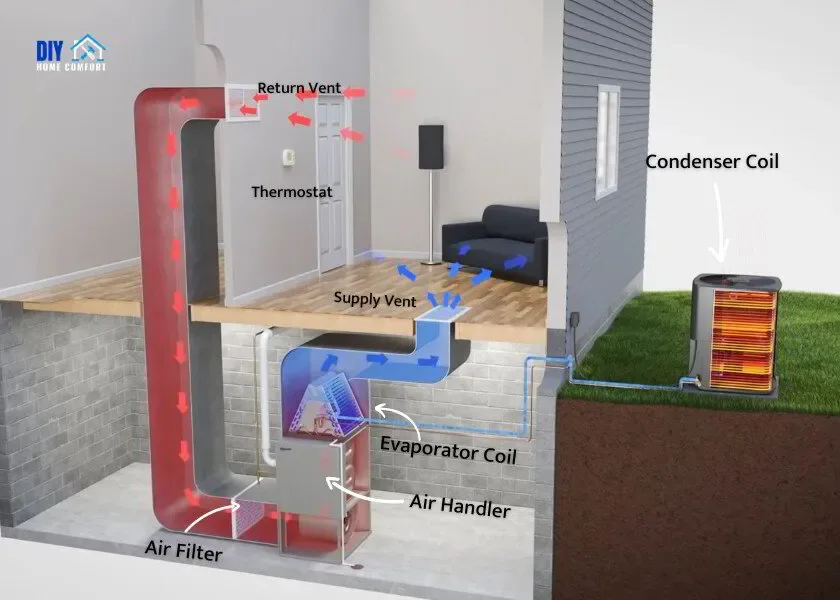
A larger unit may satisfy peak sensible load but cycle poorly at lower loads, depending on its minimum capacity and controls. That can affect comfort and humidity. Ductwork also has to deliver the required airflow without excessive static pressure or leakage.
Ask the contractor to show both design-day output and part-load behavior. Use heat-pump sizing to prepare the questions rather than buying solely by floor area.
Practical checks during a hot spell
- Verify the intended cooling mode, schedule and setpoint.
- Check the correct filter and keep supply and return paths clear.
- Keep outdoor airflow clear within the exact unit's required clearances.
- Reduce avoidable solar and internal heat gains using suitable shades and sensible appliance timing.
- Record indoor temperature, humidity, outdoor conditions and whether the system is losing ground.
🛑 Do not lower the setpoint far below the desired temperature expecting a single-stage unit to cool faster. Do not open panels, hose an indoor coil or repeatedly reset a tripped breaker. If the coil or suction line is iced, turn cooling off and follow the frozen-AC guidance.
Humidity and comfort targets
Comfortable temperature depends on occupants, humidity, air movement and health needs. A universal setpoint is not the correct target for every household. Persistent high humidity needs its own investigation; cooling capacity alone does not measure moisture removal.
Climate-zone numbers do not, by themselves, distinguish humid, dry and marine conditions. Use local weather and the building's moisture loads. If the system cannot maintain safe conditions during extreme heat, move vulnerable occupants to a cooled location and arrange service promptly.
Refrigerant and equipment age
Refrigerant choice alone does not prove better extreme-heat performance. Compare the actual system data. Existing R-410A equipment is not automatically illegal to use or service because newer product rules have changed; new-equipment restrictions and servicing are different issues. See our refrigerant guide before deciding that a functioning system must be replaced.
Conclusion
Cooling in 100-degree weather is a load-and-capacity question. Verify the matched equipment, airflow, humidity performance and building conditions, then request measured commissioning evidence rather than relying on a rating or a broad climate-zone claim.
Continue with our heat-pump guides for related homeowner decisions.

Scott Harding
Scott is the main author of DIY Home Comfort. Learn more about the team and our approach on the About page.